By Phyllis Kachere and Itai Mazire
TWENTY-FIVE refugees have died in Zimbabwe, it has been reported.
The refugees mainly from the Democratic Republic of Congo died at Tongogara Refugee Camp in Chipinge, the only refugee sanctuary in the country.
The 25 dead, died in the past nine months due to an outbreak of disease caused by the squalid living conditions under which the refugees live.
However, the Secretary for Labour and Social Services, Mr Lancaster Museka, rejected claims that there was an outbreak of disease in the camp.
“We can confirm that since the beginning of the year a total of 25 refugees have died. All nationalities are equally affected although the Democratic Republic of Congo has suffered the most with five deaths. The number of deaths recorded among the Congolese is just a reflection of the camp population ratios,” said Mr Museka.
As of end of September, the DRC had a camp population of 2 769 out of the 4 025 resident at the Chipinge camp.
Mr Museka said there was no specific common disease claiming lives in the Tongogara Refugee Camp and there has never been any disease outbreak in the camp.
According to research findings of various relief organisations on causes of deaths in refugee camps in Southern Africa, the major killers were measles, tuberculosis, diarrhoea, hepatitis B and cholera — diseases usually associated with overcrowded conditions.
A visit to the camp by our correspondent revealed poor living conditions with some refugees claiming that the food rations they received were inadequate for their day-to-day sustenance.
Teams of some camp residents building or repairing members’ mud houses could be seen going about their work.
“Living conditions in this camp are poor. While we get food rations from the Zimbabwe Government and the UN, this is not adequate. We have to build our own houses and yet we are not allowed to work. How are we surely expected to survive?” remarked Congolese citizen Mr Jose Ndage-Dikanu, whose wife and three children are also in the camp.
He said there was no resident medical doctor at the camp clinic to attend to the health needs of the 4 000-strong population.
But Mr Museka said the absence of a resident doctor was not problematic as there was an effective referral system with the Chipinge District Hospital where deserving cases were referred.
A mother with two young children also complained of the food shortages they experienced at the camp. A poster on the walls of the administration block summed up what some refugees at the camp spoke about.
It read: “Gnawing hunger, snow-bound passes, icy rivers. Finally, food, protection and three long years in a refugee camp. Then back to a ruin that once was home and a life to build again. It takes courage to be a refugee.”
Currently, Tongogara Refugee Camp has a population of 4 025 with the DRC having the highest population of 2 769. Zimbabwe hosts a total of 4 651 refugees and 646 asylum seekers from Angola, Congo Brazzaville, DRC, Eritrea, Ethiopia, Rwanda, Somalia, Sudan, Uganda, Zambia, Lebanon and Djibouti. There are 2 318 children under 18, 1 040 men, 641 women and 26 elderly people at the camp.
Mr Museka said in the event that a refugee died, the Government was not obliged to inform that person’s relatives or their country of origin.
“If a refugee dies there is no need for us to notify the home government since a refugee enjoys international protection in the country of asylum to protect him or her. The host government does not have an obligation to report to the country of origin’s government concerning the type of refugees it is hosting,” he said.
He said Government was working with the international community to facilitate the repatriation of Rwanda nationals in the camp.
“Zimbabwe and the international community are yet to sign the cession clause for the Rwandese caseload.
“Information campaign for possible voluntary repatriation of the Rwandese caseload is being done in view of the impending cession clause in December 2011.
“For the other nationalities the situation back home (country of origin) has not improved for us to discuss possible repatriation with them,” said Mr Museka.
Statistics from the Ministry of Labour and Social Welfare show that, as at August 12, there were 650 Rwandans at Tongogara Refugee Camp.
Sunday, 29 May 2011

Poverty:African women's downfall
By Phyllis Kachere
HARARE, Apr 9 (IPS) While her peers get ready to go to school each
morning, 14-year-old Matipedza (not her real name) of Marange district in
Manicaland has to stay behind to prepare breakfast for her 67-year-old
husband.
Although her marriage is not legally registered, it is customarily
recognised, and the teenager is expected to live as a housewife and soon
bear children.
"I can’t go against [the will of] my elders and leave my
husband in order to attend school. Besides, where would I go if I leave?
My parents will not welcome me," said Matipedza.
Her case is not unique. In fact, the majority of school-going girls in
Marange, some as young as ten, have been married to older men from their
church, the Johanne Marange Apostolic sect, which is infamous for
believing in polygamy. Most marriages are arranged between adult men and
under-age girls.
Although it is criminal under the recently enacted Domestic Violence Act
to marry off an under-age girl – the age of sexual consent in Zimbabwe is
16 years – it is difficult to stop these marriages, as members of the sect
are complicit and secretive.
Recently released research by Harare-based non-governmental organisation
Women and Law Southern Africa (WLSA) has shown that young girls in early
marriages are likely to suffer birth complications, some of them resulting
in death.
The WLSA study also revealed that those girls are prone to cervical
cancer, suffer psychological trauma and encounter a host of problems, such
as failing to deal with the social pressures that come with being a wife
in a polygamous union.
The findings have forced Zimbabwean authorities to step up efforts to stop
the practice that has forced thousands of girls in the Marange, Odzi and
Buhera districts of Manicaland to drop out of school.
Although current data is not available, statistics from the Ministry of
Education, Sport and Culture district office reveal that out of the 10,000
girls who enrolled in Form One in the Marange district in 2000, only about
a third completed Form Four in 2003.
&com;Those who dropped out became wives, with a small number dropping
out because they could not afford the fees,&com; said a senior
district education officer who did not want to be named.
School dropouts
Most girls stop schooling in July when the sect celebrates Passover, a
religious festivity during which marriage ceremonies take place.
Gideon Mombeshora, a sect member, told IPS that most men in the church
prefer to marry under-age girls because it is easier to control them.
&com;Most men want to get married to docile women. The younger the
bride the more chances for dominance for the man,&com; he said.
He further explained the sect strongly believes in the practice of
under-age brides: &com;Although it is not in our church’s
statutes that old men should marry under-age girls, the practice is deeply
entrenched in our belief system.&com;
Former senator Sheila Mahere said early marriages are a social ill that
threatens to derail government’s bid to fulfil its Millennium
Development Goal (MDG) on increasing access to primary education as girls
continue to drop out of the already constrained education system.
&com;Early marriages threaten national economic development, as bright
and intelligent girls are forced out of school to become cheap labour and
child bearers in their homesteads. Most of the girls become farm labourers
on their husbands’ farms,&com; she said.
The Union for the Development of Apostolic Churches in Zimbabwe-Africa
(UDA-CIZA), a coalition of 160 apostolic sects in Zimbabwe, said tries to
raise awareness among apostolic sect leaders of the dangers of early
marriages. But in most cases, it faces serious resistance.
&com;The police has been the biggest let down in early forced child
marriages as they have continued to turn a blind eye to these
crimes,&com; explain UDA-CIZA programme manager Edson Tsvakai.
&com;We sometimes report some of our members to the police for these
crimes but there have been very few successful prosecutions, largely
because police view these cases as not serious and because some of the
sect leaders are highly networked with the authorities.&com;
Serious resistance
In 2007, the Harare-based Girl Child Network, rescued an 11-year-old girl
who had been married off to a 44-year-old man in Buhera. The man was
successfully prosecuted and sentenced to six months in jail. However,
shortly thereafter, the sentence was suspended and the girl had to live in
a safe house because the unrepentant husband continued to claim her as his
wife.
Caroline Nyamayemombe, gender officer at the United Nations Population and
Development Agency (UNFPA) country office in Harare, says studies have
confirmed that teenage pregnancy is on the increase in Zimbabwe and a
leading cause of maternal mortality.
&com;Young girls are married off to men often older than their own
fathers. This scenario has significantly contributed to pregnancy
complications in teenage mothers. These harmful cultural practices are
rampant in some districts in the country,&com; she explained.
Nyamayemombe said apart from religious beliefs, poverty is one of the key
reasons for early marriages, as UNFPA data have shown that about 80
percent of pregnant teenagers come from poor families.
&com;Single adolescent girls who become pregnant are more likely to
drop out of school, thus compromising their future earning capacity and
becoming more likely to end in poverty. Maternal mortality and mortality
from HIV/AIDS related causes become a reality for these girls and often
lead or exacerbate poverty,&com; she added.
A pregnant teenager faces the risk of immature uterine muscles and mucous
membranes that pose serious danger and a high risk of a ruptured uterus in
cases of prolonged labour
HARARE, Apr 9 (IPS) While her peers get ready to go to school each
morning, 14-year-old Matipedza (not her real name) of Marange district in
Manicaland has to stay behind to prepare breakfast for her 67-year-old
husband.
Although her marriage is not legally registered, it is customarily
recognised, and the teenager is expected to live as a housewife and soon
bear children.
"I can’t go against [the will of] my elders and leave my
husband in order to attend school. Besides, where would I go if I leave?
My parents will not welcome me," said Matipedza.
Her case is not unique. In fact, the majority of school-going girls in
Marange, some as young as ten, have been married to older men from their
church, the Johanne Marange Apostolic sect, which is infamous for
believing in polygamy. Most marriages are arranged between adult men and
under-age girls.
Although it is criminal under the recently enacted Domestic Violence Act
to marry off an under-age girl – the age of sexual consent in Zimbabwe is
16 years – it is difficult to stop these marriages, as members of the sect
are complicit and secretive.
Recently released research by Harare-based non-governmental organisation
Women and Law Southern Africa (WLSA) has shown that young girls in early
marriages are likely to suffer birth complications, some of them resulting
in death.
The WLSA study also revealed that those girls are prone to cervical
cancer, suffer psychological trauma and encounter a host of problems, such
as failing to deal with the social pressures that come with being a wife
in a polygamous union.
The findings have forced Zimbabwean authorities to step up efforts to stop
the practice that has forced thousands of girls in the Marange, Odzi and
Buhera districts of Manicaland to drop out of school.
Although current data is not available, statistics from the Ministry of
Education, Sport and Culture district office reveal that out of the 10,000
girls who enrolled in Form One in the Marange district in 2000, only about
a third completed Form Four in 2003.
&com;Those who dropped out became wives, with a small number dropping
out because they could not afford the fees,&com; said a senior
district education officer who did not want to be named.
School dropouts
Most girls stop schooling in July when the sect celebrates Passover, a
religious festivity during which marriage ceremonies take place.
Gideon Mombeshora, a sect member, told IPS that most men in the church
prefer to marry under-age girls because it is easier to control them.
&com;Most men want to get married to docile women. The younger the
bride the more chances for dominance for the man,&com; he said.
He further explained the sect strongly believes in the practice of
under-age brides: &com;Although it is not in our church’s
statutes that old men should marry under-age girls, the practice is deeply
entrenched in our belief system.&com;
Former senator Sheila Mahere said early marriages are a social ill that
threatens to derail government’s bid to fulfil its Millennium
Development Goal (MDG) on increasing access to primary education as girls
continue to drop out of the already constrained education system.
&com;Early marriages threaten national economic development, as bright
and intelligent girls are forced out of school to become cheap labour and
child bearers in their homesteads. Most of the girls become farm labourers
on their husbands’ farms,&com; she said.
The Union for the Development of Apostolic Churches in Zimbabwe-Africa
(UDA-CIZA), a coalition of 160 apostolic sects in Zimbabwe, said tries to
raise awareness among apostolic sect leaders of the dangers of early
marriages. But in most cases, it faces serious resistance.
&com;The police has been the biggest let down in early forced child
marriages as they have continued to turn a blind eye to these
crimes,&com; explain UDA-CIZA programme manager Edson Tsvakai.
&com;We sometimes report some of our members to the police for these
crimes but there have been very few successful prosecutions, largely
because police view these cases as not serious and because some of the
sect leaders are highly networked with the authorities.&com;
Serious resistance
In 2007, the Harare-based Girl Child Network, rescued an 11-year-old girl
who had been married off to a 44-year-old man in Buhera. The man was
successfully prosecuted and sentenced to six months in jail. However,
shortly thereafter, the sentence was suspended and the girl had to live in
a safe house because the unrepentant husband continued to claim her as his
wife.
Caroline Nyamayemombe, gender officer at the United Nations Population and
Development Agency (UNFPA) country office in Harare, says studies have
confirmed that teenage pregnancy is on the increase in Zimbabwe and a
leading cause of maternal mortality.
&com;Young girls are married off to men often older than their own
fathers. This scenario has significantly contributed to pregnancy
complications in teenage mothers. These harmful cultural practices are
rampant in some districts in the country,&com; she explained.
Nyamayemombe said apart from religious beliefs, poverty is one of the key
reasons for early marriages, as UNFPA data have shown that about 80
percent of pregnant teenagers come from poor families.
&com;Single adolescent girls who become pregnant are more likely to
drop out of school, thus compromising their future earning capacity and
becoming more likely to end in poverty. Maternal mortality and mortality
from HIV/AIDS related causes become a reality for these girls and often
lead or exacerbate poverty,&com; she added.
A pregnant teenager faces the risk of immature uterine muscles and mucous
membranes that pose serious danger and a high risk of a ruptured uterus in
cases of prolonged labour
Avenging spirit (ngozi) demands three virgins
By Phyllis Kachere recently in Honde Valley.
“IN the commotion, I heard several voices of the Mukonas yelling that they were not leaving our homestead without me.
“I could hear my mother pleading with them that I was not at home and that she would accompany me to their homestead in Honde Valley.
“Escaping through the granary window was a non-starter as I was going to land right into the hands of the Mukonas. My mother’s pleas fell on deaf ears and eventually she was forced to fish me out of my hiding place. We were bundled together into the vehicle that the Mukonas had brought and taken away.”
As 17-year-old Varaidzo (name changed) Nyabunze of Matunduwere Village in Nyanga’s Tombo II area narrated the ordeal she suffered at the hands of the Mukona family who abducted her in March in the long-running saga of appeasing the avenging spirit of their dead relative, a stream of tears silently cascaded down her cheeks.
Varaidzo is the fourth girl to be taken away from the Nyabunzes as compensation to the Mukona family for the murder of Cloud Sundai Mukona, believed to have been murdered by her great-grandfather Sebastian Nyabunze in the 1930s.
No murder record relating to the matter exists at the Nyamaropa Police Station.
After failing to report for school at Crossdale High in Nyanga where she was doing Form 4, Varaidzo said the headmaster, Mr Mandikutse, later advised her father, Mr Thomas Nyabunze, to make a police report.
Explaining from his home in Tombo II, Mr Nyabunze (52) said he was away when the Mukona family members, some of whom were identified as Junia (35), Cloud Jnr (52) and Violet (30) came to his homestead and abducted his daughter Varaidzo.
“I then made a police report at Nyanga Police Station, but they advised me that I should make a report at my home station, which is Nyamaropa Police Station,” said Mr Nyabunze.
“They eventually accepted my report, but they said they would hand over the docket to Nyamaropa police.
“After the report, I was given a letter to take to Ruda Police Station in Honde Valley where two police details were assigned to rescue my daughter Varaidzo from the Mukona homestead near Muparutsa School,” said Mr Nyabunze.
Mr Nyabunze said during the rescue, police told him the named Mukona family members would be charged with kidnapping a minor, but until today, no one has yet been charged.
Ruda police confirmed to The Sunday Mail In-depth that they had indeed rescued Varaidzo and that Junia Mukona had been arrested by their colleagues from Nyamaropa Police Station.
“A Constable Topera from Nyamaropa Police Station came here and arrested Junia Mukona. Another elderly woman from Mukona came here and caused a stir claiming to be possessed and demanding that Junia be released,” said a police officer at Ruda, who declined to be identified as he is not authorised to speak to the Press.
“But I don’t know what later happened as we only assisted Nyamaropa police in locating the village.”
Both the officer-in-charge and his second in command at Nyamaropa Police Station professed ignorance over the matter and referred this reporter to police in Nyanga district where the officer commanding the district, Chief Superintendent N. Moyo, also professed ignorance over the matter but promised to investigate.
Violet Mukona, who was part of the group that abducted Varaidzo, said she and her sister Junia were being possessed by Sundai’s spirit in turns and it is that spirit that pushed them to go and take Varaidzo away.
“My sister Junia is the one who started to be possessed by uncle Sundai’s spirit,” she said.
“It demanded that we go and take a fresh bride from the Nyabunzes and we obliged. The Nyabunzes know their obligation and they gladly offered us Varaidzo.
“We were surprised to see Varaidzo’s father coming with policemen to take her away and arrest Junia.
“This is a long-running story and the Nyabunzes know their obligation. This spirit is the one that led us to take her.”
Violet also narrated how several Nyabunze girls had been offered to her family only for them to go back and find other men to marry them.
“This matter has been dragging on and on for too long,” said Violet Mukona during an interview at her home in Muparutsa Village.
“The Mukona family men who are supposed to be marrying these girls have not been forthcoming. Their wives have advised them against marrying the girls, but Uncle Sundai’s spirit is manifesting through my sister and I and is forcing us to go and get girls from the Nyabunzes.”
Violet Mukona said after Junia was arrested, police later released her and said she had no case to answer.
Mr Nyabunze said his family only became aware of the alleged murder by his grandfather in 1961 when his then 18-month-old Grace was handed to the Mukonas as appeasement for Sundai’s avenging spirit.
The handover, he said, was after the Nyabunzes were struck by a spate of mysterious deaths and events at their homestead, which a traditional healer attributed to Sundai’s avenging spirit.
“Grace grew up with the Mukonas until she was 18 or 19 when she joined the liberation struggle. At independence, she came back and went to the Mukonas who said they did not want to have anything to do with her because aive abata unga (she had been spoiled by gunpowder).
“They sent her back and demanded a fresh girl, leading to my other sister Norah (who was then 21) being handed over. Norah lived there for about five years and in the fifth year they called us and said she was sick,” said Mr Nyabunze.
Apparently, Norah had fallen victim to some strange sickness that resembled mental illness, said Mrs Emerentia Nyabunze, an aunt to Mr Nyabunze.
She said Norah was treated by a traditional healer and recovered, but the Mukonas sent her back in 1994, demanding a fresh bride “immune” to such illnesses.
“In 1995, I was forced to give up my daughter Monica who was doing Grade Four then. I pleaded but to no avail. They (Mukonas) took her and lived with her until she was around 19 or 20 years old,” said Mrs Marian Nyabunze, Varaidzo’s mother.
And Monica left the Mukonas to get married to another man, prompting yet another frenzy from the Mukona women who became possessed and forcibly took her away from her new husband’s family.
“Monica knew she was bequeathed to us. Why her parents allowed her to marry another man is beyond our comprehension. So we took her away from her husband and told the Nyabunzes that she could not go back until they gave us a fresh bride to replace her. And that is when we started to demand that Varaidzo be brought to us,” said Violet.
When the Mukonas took Monica from her new husband’s family, Mr Nyabunze said he had to secretly go and rescue her, but his wife, Varaidzo and two aunts remained hostage to the Mukonas.
“My wife, Varaidzo and our two aunts were only rescued by the police as the Mukonas would not let them leave, insisting they would only leave after Varaidzo had been taken to one of the Mukona men who lives in Mutare,” said Mr Nyabunze.
Sub-Chief Mary Muparutsa, under whose jurisdiction the Mukonas live, declined to comment, saying she was not aware of the matter.
“Besides, the issue of the avenging spirit is a contentious issue that has left chiefs and other traditional leaders divided. One group insists girls should form part of the payment to an avenging spirit while another group says it’s a violation of one’s human rights. So I don’t want to comment. These people never brought this matter to my attention,” said Sub-Chief Muparutsa.
There is a common belief in Zimbabwe that a murdered person should be compensated by a virgin girl, but it is a criminal offence under the Domestic Violence Act to use a girl or woman as compensation for avenging spirits or to bequeath a girl in marriage in exchange for material gain.
http://www.sundaymai...ctid=426&cat
“IN the commotion, I heard several voices of the Mukonas yelling that they were not leaving our homestead without me.
“I could hear my mother pleading with them that I was not at home and that she would accompany me to their homestead in Honde Valley.
“Escaping through the granary window was a non-starter as I was going to land right into the hands of the Mukonas. My mother’s pleas fell on deaf ears and eventually she was forced to fish me out of my hiding place. We were bundled together into the vehicle that the Mukonas had brought and taken away.”
As 17-year-old Varaidzo (name changed) Nyabunze of Matunduwere Village in Nyanga’s Tombo II area narrated the ordeal she suffered at the hands of the Mukona family who abducted her in March in the long-running saga of appeasing the avenging spirit of their dead relative, a stream of tears silently cascaded down her cheeks.
Varaidzo is the fourth girl to be taken away from the Nyabunzes as compensation to the Mukona family for the murder of Cloud Sundai Mukona, believed to have been murdered by her great-grandfather Sebastian Nyabunze in the 1930s.
No murder record relating to the matter exists at the Nyamaropa Police Station.
After failing to report for school at Crossdale High in Nyanga where she was doing Form 4, Varaidzo said the headmaster, Mr Mandikutse, later advised her father, Mr Thomas Nyabunze, to make a police report.
Explaining from his home in Tombo II, Mr Nyabunze (52) said he was away when the Mukona family members, some of whom were identified as Junia (35), Cloud Jnr (52) and Violet (30) came to his homestead and abducted his daughter Varaidzo.
“I then made a police report at Nyanga Police Station, but they advised me that I should make a report at my home station, which is Nyamaropa Police Station,” said Mr Nyabunze.
“They eventually accepted my report, but they said they would hand over the docket to Nyamaropa police.
“After the report, I was given a letter to take to Ruda Police Station in Honde Valley where two police details were assigned to rescue my daughter Varaidzo from the Mukona homestead near Muparutsa School,” said Mr Nyabunze.
Mr Nyabunze said during the rescue, police told him the named Mukona family members would be charged with kidnapping a minor, but until today, no one has yet been charged.
Ruda police confirmed to The Sunday Mail In-depth that they had indeed rescued Varaidzo and that Junia Mukona had been arrested by their colleagues from Nyamaropa Police Station.
“A Constable Topera from Nyamaropa Police Station came here and arrested Junia Mukona. Another elderly woman from Mukona came here and caused a stir claiming to be possessed and demanding that Junia be released,” said a police officer at Ruda, who declined to be identified as he is not authorised to speak to the Press.
“But I don’t know what later happened as we only assisted Nyamaropa police in locating the village.”
Both the officer-in-charge and his second in command at Nyamaropa Police Station professed ignorance over the matter and referred this reporter to police in Nyanga district where the officer commanding the district, Chief Superintendent N. Moyo, also professed ignorance over the matter but promised to investigate.
Violet Mukona, who was part of the group that abducted Varaidzo, said she and her sister Junia were being possessed by Sundai’s spirit in turns and it is that spirit that pushed them to go and take Varaidzo away.
“My sister Junia is the one who started to be possessed by uncle Sundai’s spirit,” she said.
“It demanded that we go and take a fresh bride from the Nyabunzes and we obliged. The Nyabunzes know their obligation and they gladly offered us Varaidzo.
“We were surprised to see Varaidzo’s father coming with policemen to take her away and arrest Junia.
“This is a long-running story and the Nyabunzes know their obligation. This spirit is the one that led us to take her.”
Violet also narrated how several Nyabunze girls had been offered to her family only for them to go back and find other men to marry them.
“This matter has been dragging on and on for too long,” said Violet Mukona during an interview at her home in Muparutsa Village.
“The Mukona family men who are supposed to be marrying these girls have not been forthcoming. Their wives have advised them against marrying the girls, but Uncle Sundai’s spirit is manifesting through my sister and I and is forcing us to go and get girls from the Nyabunzes.”
Violet Mukona said after Junia was arrested, police later released her and said she had no case to answer.
Mr Nyabunze said his family only became aware of the alleged murder by his grandfather in 1961 when his then 18-month-old Grace was handed to the Mukonas as appeasement for Sundai’s avenging spirit.
The handover, he said, was after the Nyabunzes were struck by a spate of mysterious deaths and events at their homestead, which a traditional healer attributed to Sundai’s avenging spirit.
“Grace grew up with the Mukonas until she was 18 or 19 when she joined the liberation struggle. At independence, she came back and went to the Mukonas who said they did not want to have anything to do with her because aive abata unga (she had been spoiled by gunpowder).
“They sent her back and demanded a fresh girl, leading to my other sister Norah (who was then 21) being handed over. Norah lived there for about five years and in the fifth year they called us and said she was sick,” said Mr Nyabunze.
Apparently, Norah had fallen victim to some strange sickness that resembled mental illness, said Mrs Emerentia Nyabunze, an aunt to Mr Nyabunze.
She said Norah was treated by a traditional healer and recovered, but the Mukonas sent her back in 1994, demanding a fresh bride “immune” to such illnesses.
“In 1995, I was forced to give up my daughter Monica who was doing Grade Four then. I pleaded but to no avail. They (Mukonas) took her and lived with her until she was around 19 or 20 years old,” said Mrs Marian Nyabunze, Varaidzo’s mother.
And Monica left the Mukonas to get married to another man, prompting yet another frenzy from the Mukona women who became possessed and forcibly took her away from her new husband’s family.
“Monica knew she was bequeathed to us. Why her parents allowed her to marry another man is beyond our comprehension. So we took her away from her husband and told the Nyabunzes that she could not go back until they gave us a fresh bride to replace her. And that is when we started to demand that Varaidzo be brought to us,” said Violet.
When the Mukonas took Monica from her new husband’s family, Mr Nyabunze said he had to secretly go and rescue her, but his wife, Varaidzo and two aunts remained hostage to the Mukonas.
“My wife, Varaidzo and our two aunts were only rescued by the police as the Mukonas would not let them leave, insisting they would only leave after Varaidzo had been taken to one of the Mukona men who lives in Mutare,” said Mr Nyabunze.
Sub-Chief Mary Muparutsa, under whose jurisdiction the Mukonas live, declined to comment, saying she was not aware of the matter.
“Besides, the issue of the avenging spirit is a contentious issue that has left chiefs and other traditional leaders divided. One group insists girls should form part of the payment to an avenging spirit while another group says it’s a violation of one’s human rights. So I don’t want to comment. These people never brought this matter to my attention,” said Sub-Chief Muparutsa.
There is a common belief in Zimbabwe that a murdered person should be compensated by a virgin girl, but it is a criminal offence under the Domestic Violence Act to use a girl or woman as compensation for avenging spirits or to bequeath a girl in marriage in exchange for material gain.
http://www.sundaymai...ctid=426&cat
Ban imported farm produce:farmers


Fruits and vegetables of South African origin being sold in a supermarket in Groombridge at the expense of local produce.
FARMERS have castigated policymakers for failure to initiate and harmonise agricultural policies that protect them as Zimbabwe gears for the regional free customs union.
Responding to questions over the Zimbabwe agricultural sector’s preparedness to join the soon-to-come free customs union, the Zimbabwe Farmers’ Union (ZFU) lambasted what it termed the unco-ordinated agricultural policies prevailing in the country with regards the importation of agricultural produce.
“We welcome agricultural produce imports for those products not readily available through local farmers, but what we have experienced is that agricultural produce is being imported willy-nilly.
“Go to local supermarkets, they are stuffed with imported vegetables and fruits. Surprisingly we have local farmers who have been forced to dump their produce for lack of markets. Importing lemons, do we really have a shortage of lemons in the country?” lamented ZFU’s first vice-president Mr Abdul Nyathi.
Mr Nyathi explained that policymakers do not consult them and this lack of consultation has led to disastrous policies that prejudice them being implemented.
“When there are shortages in the market, we have no problems with the imports. We have fought battles over the importation of foreign chicken on our market. The country was allowing cheap South African chickens into the country and these threatened local chicken production,” said Mr Nyathi.
A visit to Harare’s uptown supermarkets revealed a variety of mainly South African-imported fruits and vegetables, including locally abundant sweet potatoes.
A supermarket in Groombridge had almost all its shelves filled with South African fruits and vegetables.
Ironically on one of the South African-imported beetroot on sale in the supermarket was written, “Buying this products creates jobs”.
Queried Mr Nyathi: “Zimbabwe is now selling South African beetroot to create jobs for South Africans. Meanwhile, what is happening to Zimbabwean farmers? Farmers in Manicaland are throwing away their fruits and vegetables because no one is buying them.”
The situation was the same at other shops at Sam Levy’s Village in Borrowdale and Avondale.
In an interview with The Sunday Mail, agricultural and environmental consultant Mr Rodger Mpande explained that the prevailing situation where business imports locally available agricultural produce does not augur well for the country’s agricultural development.
“These fruits and vegetables are imported at roughly 40 percent tariff structure, but business still imports and charges premium prices for them.
“Now, if they stock their shops from local produce, wouldn’t that be empowerment for our local farmers who have been forced to throw away their produce for lack of markets?” queried Mr Mpande.
He said policymakers should be alive to international trading patterns and ensure that Zimbabwe does not become a dumping ground for both regional and overseas producers.
He queried why ZimStats (formerly Central Statistical Office) was not guiding policymakers through their statistics.
“Shouldn’t ZimStats be guiding policymakers through their provision of statistics? They should be aware of where the gaps are in the agricultural sector.
“Say, if there is a shortage of lemons, ZimStats should provide that information to farmer organisations who will then communicate with their membership to take up the opportunity in growing the lemons,” said Mr Mpande.
He also castigated farmer organisations for failing to use available data to guide them produce for both the local and export market.
For example, the Horticultural Promotions Council has produced a fruit and vegetable calendar that clearly spells out likely horticultural produce shortages, which local farmers could take advantage of.
“Policymakers should be judicious and create policies that ensure Zimbabwe does not become a dumping ground for foreign agricultural policies,” said Mr Mpande.- The Sunday Mail
Women can do it, but did they this time?
Women’s fight for political space
By Phyllis Kachere
"WOMEN can do it," but did they this time?
While for some the campaign by the Women’s Trust aimed at increasing the participation of women in politics during the recent harmonised elections has paid off, for others the number of women who have made it to the august House has fallen far too short.
Far too short for the initial Sadc requirement of at least 30 percent women participation in Parliament, which percentage the African Union has increased to 50 percent.
A combined total of 50 women from all the political parties (14 percent) would be in the House of Assembly and Senate for this Parliament. The House of Assembly has 210 seats while the Senate has 60.
Figures show that countrywide 919 women contested in the election at different levels (740 council, 118 House of Assembly, 61 Senate).
But for the Women’s Trust executive director Ms Luta Shabba, while the percentage of women who eventually made it is low, it was the high number (compared to the previous elections) who offered themselves for political office that made the difference.
"We are absolutely excited about the impact of the ‘Women Can Do It’ campaign. One of its objectives was to mobilise women to engage in the political process. And we are happy to say we managed to get a whopping 919 women participating as candidates in the harmonised elections compared to only 58 who contested for the House of Assembly seats in 2005," said Ms Shabba.
She conceded that while the number of women in the House of Assembly appeared to have increased, the increase is due to the increased number of seats that were up for grabs (from 120 previously to 210 this time).
Ms Shabba said while the 14 percent fell far too short of the AU 50 percent target, the fact that a significant 919 women offered themselves up for election could be attributed to the campaign.
"Previously, political office used to be a preserve of the original small group that made it to Parliament at independence. But the campaign managed to break that barrier and drew more women into the race.
"Most women used the ‘Women Can Do It’ campaign to lobby their political parties to reserve seats for them and for that we are excited. We mobilised resources for the women, a challenge that has always ensured that women remained behind in the campaign for political office.
"We also trained the women on leadership, which will be followed through with those who made it as we train them for Parliamentary debates, etiquette, and all that is expected of them now that they hold political office " said Ms Shabba.
But critics of the campaign say while the campaign was moving in the right direction, it came too late and could have done better if its activities had been co-ordinated and linked to other existing programmes like the Women in Politics Support (WiPSU) 50-50 campaign since they have similar goals.
"The Women Can Do It campaign could have done better if it had started earlier. That would have given more time to consult and campaign in constituencies of their choice. And if the campaign had joined hands with WiPSU 50-50 campaign, who knows, more women could have entered Parliament," said the Zimbabwe Women Lawyers’ Association (Zwla) director, Mrs Emilia Muchawa.
Mrs Muchawa said not only was the visibility of women contesting political office heightened by the campaign, but that political parties were forced to field female candidates as they sought to be in sync with the hype created by the campaign.
Unfortunately, said Mrs Muchawa, the stakes were too high in this election, that even the best women candidates lost because the electorate was voting on party lines and not for the candidates of their choice.
National co-ordinator of Women and Law in Southern Africa (Wlsa) Ms Slyvia Chirawu said while the campaign raised the visibility of women, it came too late.
"Women usually take time to decide and the late coming of the campaign did not help matters. Unfortunately some of the women candidates went into the unwinnable constituencies where they lost. Political parties should shoulder the blame as they also used women to frustrate other male candidates who would have been campaigning in particular constituencies they declared for women," said Ms Chirawu.
She said campaigning for political office was expensive and proved so for most women as they could not dish out resources to the public like their male counterparts.
Even though most of the women who stood for political office owned substantial resources, they might not be in full control of how to use them.
She said women in political offices should be willing to groom and assist new women into political office to ensure maximum participation of women in politics.
Mrs Muchawa, like Ms Chirawu, hoped that the campaign would be sustained and not wait to resurface come 2013 elections.
In concurrence with in-coming House of Assembly representative for Mutasa North Mr David Chimhini, Mrs Muchawa said the campaign should not only be reserved for entrance into Parliament but should ensure that women are positioned in all decision-making seats.
"Although women have failed to reach the AU 50 percent target in Parliament, the ‘Women Can Do It’ campaign should be used to lobby for equitable distribution of all decision-making posts in both the public and private spheres.
"But I don’t believe that men should create opportunities for women. Instead, women should be on the forefront to claim what is theirs. The campaign came too late but it should be commended for reminding the electorate that women can do it," said Mr Chimhini.
He castigated women who always moaned about the lack of resources and said these had nothing to do with being articulate about policies.
"Almost 30 years after independence, and with the age of majority, women should play their part in national and economic development. They should not play second fiddle to men although it needs to be acknowledged that the playing field for women in terms of education needs attention.
"We still have not addressed the real issues why we still have a whole school of nursing whose majority are women while in the engineering or other such fields men are the majority. Let’s put things right for women to excel," said Mr Chimhini.
Beitbridge Senator Mrs Tambudzani Mohadi said the low number of women in Parliament could be attributed to some cultural practices that discourage women from taking political office.
"While the majority of people in Zimbabwe acknowledge that women can get into politics there are still some dangerous pockets who frown on women taking political office. It is the influence of this small number that has a bearing on the low numbers of women participating," said Mrs Mohadi.
Mufakose House of Assembly representative Ms Paurina Mpariwa welcomed the "Women Can Do It" campaign for training and mobilising resources for women candidates.
"Both the major political parties made an effort to increase the number of women candidates for these elections. And the campaign helped boost women’s confidence although I think they were too neutral.
"I had hoped for them to print campaign T-shirts for the women candidates in their own party colours instead of the neutral ‘vote for a woman’ standard message. The election was more of a battle of the parties and because of that some of the best women candidates lost," said Ms Mpariwa.
Responding to queries of the readiness of the Zimbabwean electorate to vote for women politicians, Minister of Science and Technology Dr Olivia Muchena said it was ready although a little more time and resources were needed for societal attitudes to change.
She said while women lobbied in their different political parties to campaign in "winnable" seats, the allocation for seats was not democratic leading to better women candidates losing out. Some critics have accused women of trying to create an "industry" for them to loot donor funds using women, most of the women interviewed defended the campaign saying it ensured space for women to participate in politics.
"Whenever there are challenges to be addressed it is normal for the affected group to mobilise resources and strategies to lobby for the challenges to be addressed. And that is exactly what women have done," said Mrs Muchawa.
"There is nothing new in that accusation. We have heard it before and that should not discourage women to keep the pressure and maintain momentum on asking for what is rightfully ours. We will fight for our political space," said Ms Chirawu.
By Phyllis Kachere
"WOMEN can do it," but did they this time?
While for some the campaign by the Women’s Trust aimed at increasing the participation of women in politics during the recent harmonised elections has paid off, for others the number of women who have made it to the august House has fallen far too short.
Far too short for the initial Sadc requirement of at least 30 percent women participation in Parliament, which percentage the African Union has increased to 50 percent.
A combined total of 50 women from all the political parties (14 percent) would be in the House of Assembly and Senate for this Parliament. The House of Assembly has 210 seats while the Senate has 60.
Figures show that countrywide 919 women contested in the election at different levels (740 council, 118 House of Assembly, 61 Senate).
But for the Women’s Trust executive director Ms Luta Shabba, while the percentage of women who eventually made it is low, it was the high number (compared to the previous elections) who offered themselves for political office that made the difference.
"We are absolutely excited about the impact of the ‘Women Can Do It’ campaign. One of its objectives was to mobilise women to engage in the political process. And we are happy to say we managed to get a whopping 919 women participating as candidates in the harmonised elections compared to only 58 who contested for the House of Assembly seats in 2005," said Ms Shabba.
She conceded that while the number of women in the House of Assembly appeared to have increased, the increase is due to the increased number of seats that were up for grabs (from 120 previously to 210 this time).
Ms Shabba said while the 14 percent fell far too short of the AU 50 percent target, the fact that a significant 919 women offered themselves up for election could be attributed to the campaign.
"Previously, political office used to be a preserve of the original small group that made it to Parliament at independence. But the campaign managed to break that barrier and drew more women into the race.
"Most women used the ‘Women Can Do It’ campaign to lobby their political parties to reserve seats for them and for that we are excited. We mobilised resources for the women, a challenge that has always ensured that women remained behind in the campaign for political office.
"We also trained the women on leadership, which will be followed through with those who made it as we train them for Parliamentary debates, etiquette, and all that is expected of them now that they hold political office " said Ms Shabba.
But critics of the campaign say while the campaign was moving in the right direction, it came too late and could have done better if its activities had been co-ordinated and linked to other existing programmes like the Women in Politics Support (WiPSU) 50-50 campaign since they have similar goals.
"The Women Can Do It campaign could have done better if it had started earlier. That would have given more time to consult and campaign in constituencies of their choice. And if the campaign had joined hands with WiPSU 50-50 campaign, who knows, more women could have entered Parliament," said the Zimbabwe Women Lawyers’ Association (Zwla) director, Mrs Emilia Muchawa.
Mrs Muchawa said not only was the visibility of women contesting political office heightened by the campaign, but that political parties were forced to field female candidates as they sought to be in sync with the hype created by the campaign.
Unfortunately, said Mrs Muchawa, the stakes were too high in this election, that even the best women candidates lost because the electorate was voting on party lines and not for the candidates of their choice.
National co-ordinator of Women and Law in Southern Africa (Wlsa) Ms Slyvia Chirawu said while the campaign raised the visibility of women, it came too late.
"Women usually take time to decide and the late coming of the campaign did not help matters. Unfortunately some of the women candidates went into the unwinnable constituencies where they lost. Political parties should shoulder the blame as they also used women to frustrate other male candidates who would have been campaigning in particular constituencies they declared for women," said Ms Chirawu.
She said campaigning for political office was expensive and proved so for most women as they could not dish out resources to the public like their male counterparts.
Even though most of the women who stood for political office owned substantial resources, they might not be in full control of how to use them.
She said women in political offices should be willing to groom and assist new women into political office to ensure maximum participation of women in politics.
Mrs Muchawa, like Ms Chirawu, hoped that the campaign would be sustained and not wait to resurface come 2013 elections.
In concurrence with in-coming House of Assembly representative for Mutasa North Mr David Chimhini, Mrs Muchawa said the campaign should not only be reserved for entrance into Parliament but should ensure that women are positioned in all decision-making seats.
"Although women have failed to reach the AU 50 percent target in Parliament, the ‘Women Can Do It’ campaign should be used to lobby for equitable distribution of all decision-making posts in both the public and private spheres.
"But I don’t believe that men should create opportunities for women. Instead, women should be on the forefront to claim what is theirs. The campaign came too late but it should be commended for reminding the electorate that women can do it," said Mr Chimhini.
He castigated women who always moaned about the lack of resources and said these had nothing to do with being articulate about policies.
"Almost 30 years after independence, and with the age of majority, women should play their part in national and economic development. They should not play second fiddle to men although it needs to be acknowledged that the playing field for women in terms of education needs attention.
"We still have not addressed the real issues why we still have a whole school of nursing whose majority are women while in the engineering or other such fields men are the majority. Let’s put things right for women to excel," said Mr Chimhini.
Beitbridge Senator Mrs Tambudzani Mohadi said the low number of women in Parliament could be attributed to some cultural practices that discourage women from taking political office.
"While the majority of people in Zimbabwe acknowledge that women can get into politics there are still some dangerous pockets who frown on women taking political office. It is the influence of this small number that has a bearing on the low numbers of women participating," said Mrs Mohadi.
Mufakose House of Assembly representative Ms Paurina Mpariwa welcomed the "Women Can Do It" campaign for training and mobilising resources for women candidates.
"Both the major political parties made an effort to increase the number of women candidates for these elections. And the campaign helped boost women’s confidence although I think they were too neutral.
"I had hoped for them to print campaign T-shirts for the women candidates in their own party colours instead of the neutral ‘vote for a woman’ standard message. The election was more of a battle of the parties and because of that some of the best women candidates lost," said Ms Mpariwa.
Responding to queries of the readiness of the Zimbabwean electorate to vote for women politicians, Minister of Science and Technology Dr Olivia Muchena said it was ready although a little more time and resources were needed for societal attitudes to change.
She said while women lobbied in their different political parties to campaign in "winnable" seats, the allocation for seats was not democratic leading to better women candidates losing out. Some critics have accused women of trying to create an "industry" for them to loot donor funds using women, most of the women interviewed defended the campaign saying it ensured space for women to participate in politics.
"Whenever there are challenges to be addressed it is normal for the affected group to mobilise resources and strategies to lobby for the challenges to be addressed. And that is exactly what women have done," said Mrs Muchawa.
"There is nothing new in that accusation. We have heard it before and that should not discourage women to keep the pressure and maintain momentum on asking for what is rightfully ours. We will fight for our political space," said Ms Chirawu.
Forced marriages-five girls in dire straits
September 29, 2009
By Nyarai Kachere
MUTARE, Zimbabwe, Sep 29 (IPS) – Three years after being seized from their families and forced to marry and have sex with adult men in a Shona ritual to appease an avenging spirit, five teenagers are facing a dismal reality.
The girls from Honde Valley in Manicaland had to drop out of school, become under-age wives and mothers and live an impoverished life as vegetable vendors to contribute to their new families’ household income.
In 1999, Felicitas Nyakama, Nesta Maromo, Juliet Muranganwa, Precious Maboreke and Perseverance Ndarangwa, who were then between the ages of seven and 15, were handed over by their parents to the family of Gibson Kupemba as payment for the man’s murder. The girls’ relatives killed Kupemba to prepare muti, traditional medicine, which is sometimes made from body parts.
According to traditional belief, a murderer’s relatives need to appease a dead person’s spirit with virgin girls, sometimes as young as six years old. The virgin has to live with the murdered person’s family, no matter her age. When she reaches puberty, she is made the wife of one of the male members of her new family.
Kupemba’s grandson Gibson (junior) said his grandfather appeared to him in his sleep, demanding a virgin girl as compensation from each family involved in his murder. He insists the girls were not forced to offer themselves, but it was their personal choice to rescue their families from an evil spirit.
“They came here to confess on their own volition. Each girl must be accompanied by 22 heads of cattle,” said 28-year-old Kupemba junior, who married Precious Maboreke in 1999, when she was 15 years old. They have three children.
While five girls have already been pledged to the Kupembas, Kupemba junior says his family still demands twelve more virgins to avenge his grandfather’s death.
Kuripa ngozi, or virgin pledging, is a punishable offence under Zimbabwe’s Domestic Violence Act, the practice is rampant throughout the country but no perpetrator has ever been prosecuted.
The saga of the five girls began in 1995, the year Kupemba was murdered by four local grocery shop owners with the help of 13 other villagers. Kupemba’s mutilated, decomposing body was found discarded in a dry riverbed.
Some time later, locals say, Kupemba’s spirit started causing sudden ailments and deaths in the families involved, resulting in some of them confessing to killing him. The shop owners admitted to having chopped off his private parts, little fingers, tongue and a patch of hair for the preparation of traditional medicines to boost their businesses.
Despite the confessions, no arrests were made, and Kupemba’s relatives allege the shop owners bought the police’s silence.
To appease the dead man’s spirit, the families handed over the first five virgins to the Kupemba family from 1999 onwards, but the process was stalled in 2006 when children’s rights organisation Girl Child Network (GCN) compelled the police and the Department of Social Welfare to investigate the matter and return the girls to their families.
But shortly thereafter, investigations were put on ice. Headman Samanga of Honde Valley told IPS he pulled out of the Kupemba case, as all involved families had accused him of preventing them from resolving private, domestic affairs.
“In this area, people strongly believe kuripa ngozi can only be settled by offering a virgin girl. I was the lone voice against the practice, and it was soon drowned. The families believed I was hindering their efforts to settle their transgressions,” he explained.
Eventually, the police, which had rescued four of the girls from the Kupemba family and put them under the custody of GCN, ordered GCN to send the girls back to their families, who returned them to the Kupembas.
Only the mother of one of the girls, Anna Ndarangwa, says she tried to rescue her daughter from the ritual. “I had a heated argument with the Kupembas,” she said, but did not manage to take her daughter home.
Ndarangwa believes the girls were brainwashed into believing that the health and well-being of their families were dependent on their personal sacrifice. “It was like something was upon them. I don’t want my daughter to pay for a crime she did not commit. I will die fighting for her,” she declared.
Afraid to talk to the media, all five refused to be interviewed by IPS.
SOURCE: IPSNEWS-ZIMBABWE
MUTARE, Zimbabwe, Sep 29 (IPS) – Three years after being seized from their families and forced to marry and have sex with adult men in a Shona ritual to appease an avenging spirit, five teenagers are facing a dismal reality.
The girls from Honde Valley in Manicaland had to drop out of school, become under-age wives and mothers and live an impoverished life as vegetable vendors to contribute to their new families’ household income.
In 1999, Felicitas Nyakama, Nesta Maromo, Juliet Muranganwa, Precious Maboreke and Perseverance Ndarangwa, who were then between the ages of seven and 15, were handed over by their parents to the family of Gibson Kupemba as payment for the man’s murder. The girls’ relatives killed Kupemba to prepare muti, traditional medicine, which is sometimes made from body parts.
According to traditional belief, a murderer’s relatives need to appease a dead person’s spirit with virgin girls, sometimes as young as six years old. The virgin has to live with the murdered person’s family, no matter her age. When she reaches puberty, she is made the wife of one of the male members of her new family.
Kupemba’s grandson Gibson (junior) said his grandfather appeared to him in his sleep, demanding a virgin girl as compensation from each family involved in his murder. He insists the girls were not forced to offer themselves, but it was their personal choice to rescue their families from an evil spirit.
“They came here to confess on their own volition. Each girl must be accompanied by 22 heads of cattle,” said 28-year-old Kupemba junior, who married Precious Maboreke in 1999, when she was 15 years old. They have three children.
While five girls have already been pledged to the Kupembas, Kupemba junior says his family still demands twelve more virgins to avenge his grandfather’s death.
Kuripa ngozi, or virgin pledging, is a punishable offence under Zimbabwe’s Domestic Violence Act, the practice is rampant throughout the country but no perpetrator has ever been prosecuted.
The saga of the five girls began in 1995, the year Kupemba was murdered by four local grocery shop owners with the help of 13 other villagers. Kupemba’s mutilated, decomposing body was found discarded in a dry riverbed.
Some time later, locals say, Kupemba’s spirit started causing sudden ailments and deaths in the families involved, resulting in some of them confessing to killing him. The shop owners admitted to having chopped off his private parts, little fingers, tongue and a patch of hair for the preparation of traditional medicines to boost their businesses.
Despite the confessions, no arrests were made, and Kupemba’s relatives allege the shop owners bought the police’s silence.
To appease the dead man’s spirit, the families handed over the first five virgins to the Kupemba family from 1999 onwards, but the process was stalled in 2006 when children’s rights organisation Girl Child Network (GCN) compelled the police and the Department of Social Welfare to investigate the matter and return the girls to their families.
But shortly thereafter, investigations were put on ice. Headman Samanga of Honde Valley told IPS he pulled out of the Kupemba case, as all involved families had accused him of preventing them from resolving private, domestic affairs.
“In this area, people strongly believe kuripa ngozi can only be settled by offering a virgin girl. I was the lone voice against the practice, and it was soon drowned. The families believed I was hindering their efforts to settle their transgressions,” he explained.
Eventually, the police, which had rescued four of the girls from the Kupemba family and put them under the custody of GCN, ordered GCN to send the girls back to their families, who returned them to the Kupembas.
Only the mother of one of the girls, Anna Ndarangwa, says she tried to rescue her daughter from the ritual. “I had a heated argument with the Kupembas,” she said, but did not manage to take her daughter home.
Ndarangwa believes the girls were brainwashed into believing that the health and well-being of their families were dependent on their personal sacrifice. “It was like something was upon them. I don’t want my daughter to pay for a crime she did not commit. I will die fighting for her,” she declared.
Afraid to talk to the media, all five refused to be interviewed by IPS.
SOURCE: IPSNEWS-ZIMBABWE
The process of judicial hanging
Please note! As this page contains images of real executions which some may find disturbing they must be accessed manually by clicking on the links.
Introduction.
Hanging is the oldest but most widely used method of execution in the world today. In 2010 at least 238 hangings were recorded in six countries, down from 337 in seven countries during 2009. These executions took place in Bangladesh, Egypt, Iran, Iraq, Japan and Sudan. Five women were hanged, four in Iran and one in Egypt during 2010. Iran also carried out a small number of public hangings of men. Sadly, the majority of those hanged in the 21st century have still had to die by strangulation, particularly in Iran. It is estimated that only 36 of the hangings during 2010 used a drop designed to break the prisoner's neck.
Hanging remains the standard method of execution in many retentionist countries, notably Japan, Singapore, Malaysia, South Korea, India, Pakistan, Bangladesh, several African countries, including Botswana and Zimbabwe, and some Middle Eastern countries including Iran, Iraq, Egypt, Jordan, Kuwait, Lebanon and Syria and in most Caribbean states. It is also a lawful method as an option to lethal injection in the American state of Washington which has carried out two hangings since the re-introduction of the death penalty in 1976.
It was used extensively in Iraq under Saddam Hussein and continues to be the lawful method there under the new government which reportedly carried out 17 executions during 2010 according to official figures. These further stated that there have been 257 executions from August 2005 to December 2010, including those of six women. Iraq has adopted the American style of hanging.
Hanging originated as a method of execution in Persia (now Iran) about 2500 years ago for male criminals only, (women were strangled at the stake for the sake of decency!) It was the method of choice in many countries as it produced a highly visible deterrent without the blood and gore of beheading. In early times, it was considered ideal because it was the simplest method to carry out, did not give the condemned person a particularly cruel death (by the standards of the day), made a good public spectacle as the prisoner was above the level of the viewers and because the equipment was easy to come by - a tree, a piece of rope and a ladder or cart, being available everywhere. Unlike beheading there was no requirement for a skilled executioner. Beheading was the other most common form of execution, adopted as the sole means by some countries.
There is no means of knowing how many people have hanged worldwide in the last 2,000 years but it is probably at least half a million. From 1800 and 1964, over 5,000 people suffered death by hanging in Britain. In America it is estimated that some 9,300 people including up to 356 women were hanged from the early 1600's up to 1996.
Hanging was the normal form of execution in many countries up to the end of the 19th century when there was a general trend to abolition or to use more humane methods than the type of hanging used at that time (short drop). It was the standard method in Britain and its colonies and was widely used in France prior to the French Revolution and also in Germany and pre-communist Russia. It was the lawful method in all states of America up to 1890 and continued in some until suspension of the death penalty in 1968. Hanging was also used by many other countries that have since abolished capital punishment such as Australia, Austria, Canada, Czechoslovakia, Hungary, Ireland, New Zealand, Poland and South Africa. Hitler reintroduced it to Nazi Germany and very large numbers of prisoners were executed by this method in prisons, concentration camps and in the "field" by German soldiers between 1937 and 1945 (see The execution of women by the Nazis during World War II).
The processes of judicial hanging.
Hanging using little or no drop is still used by some Middle Eastern countries, notably, Iran. It is far more common in the 21st century than long drop hanging.
Short drop hanging was effectively universal up to around 1850 and was usually carried out in public. The prisoner could be suspended by a variety of means, from the back of a cart (or later a motor vehicle), from a horse as was sometimes used in America, by removing the platform on which they stood, as was used in Nazi hangings and also in present day Iranian ones carried out inside prisons, or by some form of trap door drop mechanism as was used in Britain from 1760 and adopted by many other countries.
This 1809 picture of the triple hanging on the “New Drop” gallows outside the Debtor's Door of Newgate in London shows clearly how little drop was given at that time.
Suspension hanging.
This method is currently used in Iran for public hangings and was also used for some executions when the Taliban controlled Afghanistan where executees were hanged from the barrels of tanks and from mobile crane jibs. In Iran, both mobile crane and recovery truck jibs are used. All of these have hydraulic mechanisms for raising them, so the jib serves as both the gallows and the means of getting the prisoner suspended.
In America, instead of the conventional gallows that dropped the prisoner through a trapdoor, some states used a method where weights connected to the rope jerked the person upwards when they were released by the hangman. This method was used in 1874, for the hanging of William E. Udderzook in West Chester, Pennsylvania and also for Charles Thiede in Utah in 1896.
Connecticut used a similar arrangement for the execution of Gerald Chapman on April the 26th, 1926. A weight was connected to the rope which passed over a pulley. The warden operated a lever with his foot to allow the weight to fall, so pulling Chapman 12 feet into the air with such force that his neck was broken. In New York state Roxalana Druze was rather less fortunate when she was hanged for the murder of her husband in 1887. As a result New York developed electrocution as its method of execution although men continued to be hanged there until the end of 1889.
Standard drop hanging.
A standardised drop, of between four and six feet, was used in many American hangings during the later part of the 19th century and into the early 20th century. This was not worked out against the weight of the individual, but was often equivalent to their height. It was considered as an advance on the short drop method previously used. A drop of this distance was often not sufficient to break the prisoner's neck, however, and many still died by strangulation, although in a lot of cases they were knocked unconscious by the force of the drop and the impact of the heavy coiled knot against the side of the neck. Occasionally, they were decapitated when the drop proved to be too long, as happened at the execution of Eva Dugan in Arizona in 1928. Standard drops were given to the eleven senior Nazis executed after the Nuremberg trials and several were reported to have died slowly. The Lincoln conspirators were given a drop of five feet at their hanging in 1865 and at least two of the four struggled for some time after they were suspended.
The "Long drop" or measured drop method.
In 1872, William Marwood introduced the concept of an accurately calculated drop for the execution of Frederick Horry at Lincoln prison, as a scientifically worked out way of giving the prisoner a humane death. This concept had been invented by doctors in Ireland and was in use there by the mid 1850’s. Longer drops were in use elsewhere by this time, e.g. in America and Ireland, but the short drop was still used by many countries at this time e.g. Austria, Czechoslovakia, Poland & Russia.
The long drop method was designed to break the prisoner’s neck by allowing them to fall a pre-determined distance and then be brought up with a sharp jerk by the rope. At the end of the drop, the body is still accelerating under the force of gravity but the head is constrained by the noose. If the eyelet is positioned under the left angle of the jaw it rotates the head backwards, which combined with the downward momentum of the body, breaks the neck and ruptures the spinal cord causing instant deep unconsciousness and rapid death. The later use of the brass eyelet in the noose tended to break the neck with more certainty. It is only in the last six inches or so of the drop that the physical damage to the neck and vertebrae occur as the rope constricts the neck and the force is applied to the vertebrae. The duration of this part of the process is between 0.2 and 0.3 of a second depending upon the length of drop given. Generally the diameter of the noose is found to have reduced some five to seven inches after the drop.
The accurately measured and worked out drop removed most of the prisoner's physical suffering and made the whole process far less traumatic for the officials who now had to witness it in the confines of the execution shed instead of in the open air.
The drop given in the 19th century was usually between 4 and 10 feet depending on the weight and strength of the prisoner. The weight used to calculate the correct drop is that of the prisoner's clothed body. Up to 1892, the length of drop was calculated to provide a final "striking" force of approximately 1,260 ft/lbs. force which combined with the positioning of the eyelet caused fracture and dislocation of the neck, usually at the 2nd and 3rd or 4th and 5th cervical vertebrae. This is the classic "hangman's fracture". The length of the drop was worked out by the formula 1,260 foot pounds divided by the body weight of the prisoner in pounds = drop in feet. Between 1892 and 1913, a shorter length of drop was used, probably to avoid the decapitation and near decapitations that had occurred with old table. The 1892 table produced a force of 840 ft/lbs. After 1913, other factors were also taken into account and the drop was calculated to give a final "striking" force of around 1,000 ft/lbs. The Home Office issued a rule restricting all drops to between 5 feet and 8 feet 6 inches as this had been found to be an adequate range. In Britain, the drop was worked out and set to the nearest quarter of an inch to ensure the desired outcome.
A proper table of drops for hangmen to use was issued by the Home Office in 1892 and were subsequently revised in 1913. The 1913 table is still used in Singapore and probably Malaysia and may have been adopted by other countries which use the British method, e.g. Australia, Canada, the Caribbean nations and Egypt. Pakistan, India and Bangladesh use the measured long drop but it is not known whether they use the British drop tables.
British drop tables.
The weight of the prisoner is the weight recorded when they were weighed, clothed, the day before execution.
The American Military manual specifies broadly similar drops to the above.
The graph below shows how long it takes to drop a given distance.

How hanging causes death.
Short drop and simple suspension hanging.
Hanging with little or no drop may cause death by strangulation (asphyxia) due to the weight of the person's body on the noose, causing it to tighten, so constricting the trachea (air passage). In this case the condemned typically exhibit signs of physical struggling for some time after suspension, 1-3 minutes being normal. There is then often a quiescent phase before what can be described as the convulsive phase which is thought occurs after consciousness has been lost. You can read reports of executions in the 18th/19th centuries where the person was said to be “greatly convulsed” The legs were drawn up and their chests heaved but this does not necessarily indicate consciousness in the second phase.
It was often reported in the 17th and 18th centuries that the prisoner died "almost without a struggle” and they would be seen to writhe in pain for just a few seconds, if at all, before going limp. This is because of pressure of the tightening noose occluding the jugular vein and carotid arteries causing cerebral ischemia, i.e. a severely reduced blood supply to the brain. Compression of the carotid bodies by the noose can also cause rapid heart stoppage due to carotid sinus reflex. In a recent public hanging in Iran which was filmed the two male prisoners seemed to go limp as soon as they were hoisted into the air and showed no signs of physical struggle. The third prisoner, a woman, struggled hard for approximately one minute before becoming still. (See later for a description of this execution)
The vertebrae protect the vertebral and spinal arteries which also supply blood to the brain. However, these arteries go outside the fourth vertebrae instead of inside it, which subjects them to blockage if the pressure on the neck is high enough (usually about 40-50 lbs. for a normal person) and this can cause the loss of consciousness in less than 15 seconds. During suspension, once the prisoner has become unconsciousness, rippling movements of the body and limbs may occur for some time which are usually attributed to nervous and muscular reflexes. Where death has been caused by strangulation, the face will typically have become engorged and cyanosed (turned blue through lack of oxygen). There will be the classic sign of strangulation - petechiae - little blood marks on the face and in the eyes from burst blood capillaries. The tongue may protrude. Where death has occurred through carotid or Vagal reflex, the face will typically be pale in colour and not show petechiae. There exist many reports and pictures of actual short drop hangings which seem to show that the person died quickly and fairly peacefully, while others indicate a slow and agonising death by strangulation.
Occasionally, a prisoner can be revived, even after hanging for half an hour and there are several recorded cases of this where people lived for many years afterwards. In Britain, to prevent survival, a slightly longer drop of about 12-18 inches became normal to ensure death, however, this extra drop tended to cause the condemned to suffer more as it was not long enough to break the neck but the force of it tore the neck muscles and sometimes the skin.
“Pole hanging”.
Austria, Czechoslovakia and Hungary used an unusual variant of short drop hanging. There was no gallows as such, but rather a stout vertical wooden pole (or post) of about 2-3 meters height with a metal hook or eye bolt at the top to which a thin rope noose was attached. There was either a ladder or steps up to a small platform at the back of the pole for the executioner to stand on. The pinioned prisoner was placed with their back to the pole and then lifted up either manually by the hangman’s assistants, on a simple board platform or by a cloth sling running under their armpits so that the executioner could put the noose round their neck. At the signal they were now jerked downwards by the assistants thus tightening the noose. This jerk combined with the thinness of the cord typically caused a carotid reflex and led to rapid unconsciousness. Late 19th century Austrian hangman, Josef Lang, considered this method to be far more humane than American style standard drop hanging and claimed that no criminal suffered for more than a minute with his method. It is unclear when pole hanging ceased although it was definitely in use until after the end of World War II and was used on various war criminals. A video of the hanging of Karl Hermann Frank which took place on the 22nd of May 1946 in Prague’s Pankrác Prison is currently available on YouTube. He was lifted up to the top of the pole by a sling and then dropped about a meter, the hangman covering Frank’s face with his hand. This film clearly demonstrates how pole hanging worked and does not give the impression that Frank struggled after suspension. There are also photos of the execution of Serbs by the Austrians during the war. It is quite probable that Milada Horakova (female) who was convicted of treason by the communist regime in Czechoslovakia suffered this death when she was hanged on 27th of June 1950. It has been reported that her executioner was ordered to “let the bitch suffocate”.
After the end of World War II, Albert Pierrepoint who hanged eight men at Karlou in Austria for war crimes, taught Austrian hangmen the British method and this was used for the last few executions there. Austria’s last execution took place on the 24th of March 1950 when Johann Trnka was hanged for murder. It is not known whether Czechoslovakia and Hungary continued to use pole hanging or a more conventional gallows for executions from the 1950’s. Czechoslovakia’s last execution was in 1989 and Hungary’s in 1988.
Standard drop hanging.
Where the standard drop proves inadequate to break the neck, the prisoner seems often to suffer a more cruel death than where little or no drop is used. The force generated by a drop of 5 or 6 feet is very considerable and does great damage to the skin, muscles and ligaments of the neck but does not necessarily induce asphyxia any sooner. This description of a hanging at San Quentin prison in California is from Clinton Duffy who was the warden there from 1942 to 1954 and relates to the execution of Major Raymond Lisemba on May 9th, 1942. "The man hit bottom and I observed that he was fighting by pulling on the straps, wheezing, whistling, trying to get air, that blood was oozing through the black cap. I observed also that he urinated, defecated, and droppings fell on the floor, and the stench was terrible". "I also saw witnesses pass out and have to be carried from the witness room. Some of them threw up."
It took ten minutes for the condemned man to die. When he was taken down and the cap removed, "big hunks of flesh were torn off" the side of his face where the noose had been, "his eyes were popped," and his tongue was "swollen and hanging from his mouth. His face had turned purple." Fortunately not all standard drop hangings were so gruesome and many prisoners did not show any signs of physical suffering.
The measured or long drop.
It takes between a half and three quarters of a second for a person to reach the end of the drop after the trap opens. The force produced by the prisoner's body weight multiplied by the length of fall and the force of gravity, coupled with the position of the noose is designed to violently jerk the person’s head backwards and sideways. In medical terms this is known as hyperflexion of the neck, which causes fracture-dislocation of the upper neck vertebrae, ideally between the C2 & C3 vertebrae, crushing or severing the spinal cord leading to immediate unconsciousness. The cause of death is however comatose asphyxia as the rope constricts the Carotid Artery, Jugular vein and the trachea (wind-pipe). It is thought that brain death will occur in around 6 minutes and whole body death normally within 10-15 minutes. It is very variable, however, with official reports of from 3-25 minutes for total death to have occurred. Some slight movements of the limbs and body may occasionally occur but are almost certainly due to spinal reflexes. Here is an official government photograph of the long drop hanging of an Iranian drug trafficker in Kuwait in 1998.
The Post-mortem report.
Some parts Britain, e.g. London typically carried a post-mortem during the 20th century on the executed person's body to establish the exact cause of death and we are fortunate to have the report of Ruth Ellis' autopsy as carried out by Professor Keith Simpson, who was one of the most eminent pathologists of his day. I have reproduced it as closely as possible to the original 1950's typewriter style. Post mortems were also carried out in other countries.
Signed Keith Simpson
M. D. Lond.
146, Harley St. W. 1 and Guy's Hospital (Pathologist)
Registrar in Forensic Medicine London University
The gallows.
All manner of patterns of gallows have been used worldwide over the years. Simple gallows, having an upright with a projecting beam cross braced to it were commonly used in many countries, even up till the end of the World War II.
However for a variety of reasons, gallows’ designs became more elaborate. From 1783, the gallows at Newgate in London had a trapdoor and as the concept of giving the prisoner some drop became more widely used, this style spread. The earliest use of the "New Drop", as it was called in Britain was on May 5th, 1760 for the execution of the Earl of Ferrers. This was in the form of a small box like structure rising about 12 inches from the main platform which would drop level with the floor when the hangman pulled away the supporting props.
The American gallows, shown in this picture, is what many of you would probably imagine a gallows to look like and is from 1894. This style was used extensively in America and most other countries up until the early part of the 20th century. The present day gallows in Washington's Walla Walla prison looks most unlike this traditional pattern, consisting simply of two massive iron eye bolts through which the rope passes, each set over a single leaf trap operated by an electromagnetic release mechanism. (See picture). America typically used a single leaf trap whereas Britain and countries which adopted British style hanging typically use(d) a two leaf trap.
Modern gallows in Australia, Britain, Singapore, Malaysia and former British colonies typically have no steps and use double trapdoors, normally operated by a lever on the platform. South Africa used a metal beam that could be used for up to seven prisoners simultaneously at Pretoria Central Prison prior to abolition. In early 20th century British execution rooms there were no uprights, the ends of beam being set into the walls, while later a concealed beam running above the ceiling was used, as was the case at Pentonville and Wandsworth prisons in London up to abolition.
Lebanon used this quite complex style of gallows for public hangings - the picture is of the public execution of two men, carried out on the 25th of May 1998.
Visit the Gallows Galleries for pictures of gallows from Britain and around the world.
The Noose.
Several types of noose are in use worldwide. At its simplest, a noose is just a slip knot fashioned on a length of rope or strong cord. Nazi executioners used this pattern during World War II, typically made from 6-10 mm thick cord.
The traditional hangman's noose (picture) has from 5 to 13 coils which slide down the rope delivering a heavy blow to the side of the neck. This pattern is still used in America and countries such as Iran and Iraq. The modern American coiled noose is prepared in accordance with a procedure laid down in a U.S. army manual, from 30 feet of 3/4"-1" diameter manila hemp rope, boiled to take out stretch and any tendency to coil. It is formed into six coils and then waxed, soaped or greased to assure that the knot slides easily. Generally the knot is placed under the prisoner’s left ear (the subaural position) as was seen in the photographs of Saddam Hussein.
Britain and most Commonwealth and ex-Commonwealth countries use(d) a simple noose consisting of a loop worked into one end of the rope with the other end passed through it, as shown here. In the 20th century the eyelet was typically placed below the angle of the jaw, (the submental position)
This was improved in the 1890's by passing the free end of the rope through a brass eyelet instead of a loop of rope, which made it more free running. This type of noose has been shown to cause a quicker death. It is usually made from a 13 foot length of 3/4" diameter hemp rope, often bound with leather, as seen here. This type of noose is used in present day Egypt, Kuwait, Singapore and Malaysia and in former British colonies. Modern materials such as Nylon have been tried but tended to be too elastic for long drop hangings. Iran uses nylon rope for its short drop/suspension hangings.
The hood.
In most countries, at least throughout the 20th century, it has been customary to hood the prisoner before execution. Normally, a black cotton or denim hood is used as shown here, but in some countries, notably Britain and its former colonies, a white linen or cotton hood was the norm as seen here. In South Africa and Australia a white hood was also used which was put on in the prisoner's cell prior to them being led into the gallows chamber. Unlike the British version, it had a flap over the eyes which was only closed just before the drop. Typically, the prisoner is hooded only at the last moment before the noose is put round their neck and adjusted. Although they are able to see the gallows, the trap, the executioner and witnesses and the noose dangling before them, most countries found it to be better than hooding them earlier and trying to lead them to the gallows, as they were more frightened by not knowing what was happening. It is thought that Iraq, Malaysia and Singapore hood the prisoner before leading them to the execution chamber.
Some places such as Iran do not use a hood, although a blindfold may be used at some public executions. There are three good reasons for hooding the prisoner. Firstly, in long drop hangings it is very important that the condemned person does not move at the last moment, just as the lever is being pulled - which could easily alter the position of the noose and thus cause them a slower death.
The second reason is to minimise rope burn and marking of the skin of the neck which is why the hood is generally put over the head before the noose. This also prevents the hood being blown off by the updraft created by the body falling.
Hooding saves the officials, who have to witness the execution, from seeing the condemned person's face as they are about to die and after suspension.
Pinioning.
In modern times it is normal to pinion the prisoner's hands either in front of them or more usually behind their back with either handcuffs or a leather strap. Some countries use additional straps for the arms or even elaborate leather harnesses for the arms and wrists, as in Kuwait. In long drop/standard drop hangings, the prisoner's legs are normally pinioned with a cord or strap around the ankles to prevent them getting their feet onto the sides of the trap when the doors fall. In Britain, as women's skirts got shorter in the 20th century, an extra strap was placed round the lower thighs to prevent the skirt billowing up as they dropped and exposing their underwear. Thigh straps were also used for men in some countries, notably in the USA.
For short drop and suspension hangings, the legs were and still are, often left free.
Charles Campbell, who was hanged in Washington in May 1994, was strapped to a special collapse board (visible in the photo of the Walla Walla gallows, above) as he was not able to support himself at the end. Other prisoners have been hanged strapped to chairs, both they and the chair falling through the trap.
Modern hangings described.
Many countries carry out hanging executions in complete secrecy, e.g. Botswana, Malaysia, Japan and Singapore so details are hard to come by. There are however, a few modern hangings which have been reported in detail or actually filmed.
Compare these to a 1950's British hanging described in my History of Judicial Hanging in Britain.
A Kuwait hanging in 2004.
Three men who had been convicted of a particularly cruel “honour” murder of a little girl called Amna Al-Khaledi were hanged at the Nayef Palace in Kuwait City on Monday the 31st of May 2004. The prisoners were Marzook Saad Suleiman Al-Saeed, aged 25, Saeed Saad Suleiman Al-Saeed, aged 28, and 24-year-old Kuwaiti Hamad Mubarak Turki Al-Dihani. They were brought to the Nayef Palace at 8.45 on the Monday morning and were allowed time to prepare and pray before they were hanged. At about 9.45 they were led to the white painted metal and wood gallows wearing regulation brown boiler suits and with their wrists and arms strapped behind them with leather straps. Here they were made to climb the steps up onto the platform some 10 feet above and were placed upon individual double trap doors. Each prisoner was allocated a three man execution team, all wearing black overalls and ski masks. Once on the trap a leather strap was placed around each man’s ankles and a British style, leather covered eyelet noose placed over his head, held in place by a heavy rubber washer and followed by a black hood. They were given measured drops (of about 7 feet) and afterwards examined by doctors with stethoscopes to determine the time of death. Marzook Saad Suleiman Al-Saeed was pronounced dead after eight minutes, Hamad Al-Dehani took six minutes to die, and Saeed Saad Suleiman Al-Saeed expired in five minutes and 20 seconds. The time of death being stated as when there is no longer a audible heartbeat. From the photographs and the length of drop it is likely that their necks were broken. There was no report of any of the men struggling after the drop fell and all seemed to become limp immediately. The aftermath of the execution was witnessed by over 1000 people, including Amna’s relatives who were let into the compound to view the dangling bodies. The scene was photographed by press photographers for publication in the following day’s papers. Click here for a photograph. It is interesting to note that the time taken for these men to die is about the same as recorded in typical lethal injection executions in the USA.
Saddam Hussein hanged in Iraq in 2006.
Probably the most high profile execution in modern times took place on at 6:10 a.m. on December the 30th 2006 when the former Iraqi dictator, Saddam Hussein was hanged by his own people in a two-story building in the Shia Khadamiya District in Northern Baghdad. Saddam was dressed in a white shirt and dark overcoat for his execution. He was led up the long flight of steps to the gallows platform where he was positioned over the chequer plate metal trap doors. The rope was looped through a metal eye on the ceiling and the free rope hung down to its attachment point. A black scarf and a seven coil American style noose were placed round his neck. He refused the traditional hood and after being taunted by his guards, the trapdoors were released and he dropped a little more than his own height through the trap and was brought to a halt by the noose which had its knot positioned under his left ear. From the cell phone video and still photographs it would seem that his neck was broken and that he died without any struggle. He was taken down after hanging for just ten minutes. Click here for a photo. Saddam had been convicted of the murder of 148 Shias in the town of Dujail in the 1980s.
An Iranian hanging in 2007.
On the 15th of July 2007 a 29 year old Iranian woman, whose name was only given as Houriyeh, was hanged in public together with her two male accomplices. She had murdered her husband by strangling him in his sleep and paid the two men, Farhad and Reza, to murder three of her in-laws. They strangled her husband’s parents and stabbed his brother to death. Houriyeh was given a head-to-toe black chador for her execution which seems to be the standard dress for condemned women in Iran. The three prisoners were bought to the execution ground, their legs shackled and the hands cuffed behind them. The American style coiled nooses were attached to a spreader bar suspended from the jib of a crane. At the signal all three were simultaneously lifted off the ground and became fully suspended. The two men appeared to become unconscious almost instantly but a few seconds after being lifted into the air Houriyeh began to struggle hard, continuing for just over a minute before becoming still. Some 5,000 people, including judiciary and police officials, witnessed the execution and it was secretly videoed on a mobile phone. The video seems to bear out 19th century newspaper reports of short drop hangings in Britain and the USA, where women often seemed to die harder than men. Click here for a photograph.
Many people who support capital punishment feel that lethal injection is a better, more modern and humane form of execution than hanging. Is this view based upon the facts or is it purely a perception based on the fact that we have experienced (non-lethal) injections ourselves? It is noticeable that the a majority of the American respondents to my surveys cite lethal injection as the method they would choose for themselves, although a considerable minority of British respondents of both sexes chose hanging.
Execution by lethal injection takes much longer than any other method, anything up to 45 minutes for the complete process during which the prisoner is fully conscious except for the last 7-10 of those minutes (remember that in Britain a 20th century hanging took, typically 15-20 seconds to carry out). This duration must subject the prisoner to far more mental torture because they know they are being put to death. Lethal injection is clearly much less dramatic than hanging and, therefore, probably easier for the staff and witnesses to cope with. It is suitable for both sexes and all ages of prisoners where a suitable vein can be located. However, there is often a problem where the prisoner has been an intravenous drug user or simply has small veins which tend to contract even further when they are frightened.
One wonders if lethal injection is perceived as being as much of a deterrent as hanging in the minds of criminals or whether they would feel it was a "soft option"?
This is an important point because if the state is going to take the life of a person at all, then surely it should seek to produce the maximum deterrence from so doing without resorting to extreme cruelty. For a detailed look at lethal injection, click here.
Conclusions.
Carried out carefully and humanely, using an accurately measured drop and modern noose, hanging is possibly the least cruel way to execute a criminal. In 20th century Britain, the whole process was over extremely quickly and every effort was made to minimise the criminal's mental and physical suffering. However, as can be seen from the examples cited above, it can also be a very cruel death, if either botched or carried out in such a way as to intentionally cause suffering. It is probable that the countries that execute criminals using little or no drop in public do so in the hope of achieving maximum deterrence and feel that the criminal should be made to suffer for what they have done.
Introduction.
Hanging is the oldest but most widely used method of execution in the world today. In 2010 at least 238 hangings were recorded in six countries, down from 337 in seven countries during 2009. These executions took place in Bangladesh, Egypt, Iran, Iraq, Japan and Sudan. Five women were hanged, four in Iran and one in Egypt during 2010. Iran also carried out a small number of public hangings of men. Sadly, the majority of those hanged in the 21st century have still had to die by strangulation, particularly in Iran. It is estimated that only 36 of the hangings during 2010 used a drop designed to break the prisoner's neck.
Hanging remains the standard method of execution in many retentionist countries, notably Japan, Singapore, Malaysia, South Korea, India, Pakistan, Bangladesh, several African countries, including Botswana and Zimbabwe, and some Middle Eastern countries including Iran, Iraq, Egypt, Jordan, Kuwait, Lebanon and Syria and in most Caribbean states. It is also a lawful method as an option to lethal injection in the American state of Washington which has carried out two hangings since the re-introduction of the death penalty in 1976.
It was used extensively in Iraq under Saddam Hussein and continues to be the lawful method there under the new government which reportedly carried out 17 executions during 2010 according to official figures. These further stated that there have been 257 executions from August 2005 to December 2010, including those of six women. Iraq has adopted the American style of hanging.
Hanging originated as a method of execution in Persia (now Iran) about 2500 years ago for male criminals only, (women were strangled at the stake for the sake of decency!) It was the method of choice in many countries as it produced a highly visible deterrent without the blood and gore of beheading. In early times, it was considered ideal because it was the simplest method to carry out, did not give the condemned person a particularly cruel death (by the standards of the day), made a good public spectacle as the prisoner was above the level of the viewers and because the equipment was easy to come by - a tree, a piece of rope and a ladder or cart, being available everywhere. Unlike beheading there was no requirement for a skilled executioner. Beheading was the other most common form of execution, adopted as the sole means by some countries.
There is no means of knowing how many people have hanged worldwide in the last 2,000 years but it is probably at least half a million. From 1800 and 1964, over 5,000 people suffered death by hanging in Britain. In America it is estimated that some 9,300 people including up to 356 women were hanged from the early 1600's up to 1996.
Hanging was the normal form of execution in many countries up to the end of the 19th century when there was a general trend to abolition or to use more humane methods than the type of hanging used at that time (short drop). It was the standard method in Britain and its colonies and was widely used in France prior to the French Revolution and also in Germany and pre-communist Russia. It was the lawful method in all states of America up to 1890 and continued in some until suspension of the death penalty in 1968. Hanging was also used by many other countries that have since abolished capital punishment such as Australia, Austria, Canada, Czechoslovakia, Hungary, Ireland, New Zealand, Poland and South Africa. Hitler reintroduced it to Nazi Germany and very large numbers of prisoners were executed by this method in prisons, concentration camps and in the "field" by German soldiers between 1937 and 1945 (see The execution of women by the Nazis during World War II).
The processes of judicial hanging.
There are four main forms of hanging.
- Short drop hanging where the prisoner drops just a few inches, and their suspended body weight and physical struggling causes the noose to tighten, normally resulting in death by strangulation or carotid or Vagal reflex. Pole hanging is a variation on this method.
- Suspension hanging where the executee is lifted into the air using a crane or other mechanism. Death is caused in the same way as with short drop hanging.
- Standard drop hanging where the prisoner drops a predetermined amount, typically 4-6 feet, which may or may not break their neck. This was the normal method adopted in America in the later 19th and early 20th centuries.
- Finally, measured or long drop hanging as practised in Britain from 1874, where the distance the person falls when the trapdoors open is calculated according to their weight, height and physique and is designed to break the neck. This method was adopted in British Colonies and by some other countries who wished to make executions more humane.
Each of these processes are examined in detail below.
Hanging using little or no drop is still used by some Middle Eastern countries, notably, Iran. It is far more common in the 21st century than long drop hanging.
Short drop hanging was effectively universal up to around 1850 and was usually carried out in public. The prisoner could be suspended by a variety of means, from the back of a cart (or later a motor vehicle), from a horse as was sometimes used in America, by removing the platform on which they stood, as was used in Nazi hangings and also in present day Iranian ones carried out inside prisons, or by some form of trap door drop mechanism as was used in Britain from 1760 and adopted by many other countries.
This 1809 picture of the triple hanging on the “New Drop” gallows outside the Debtor's Door of Newgate in London shows clearly how little drop was given at that time.
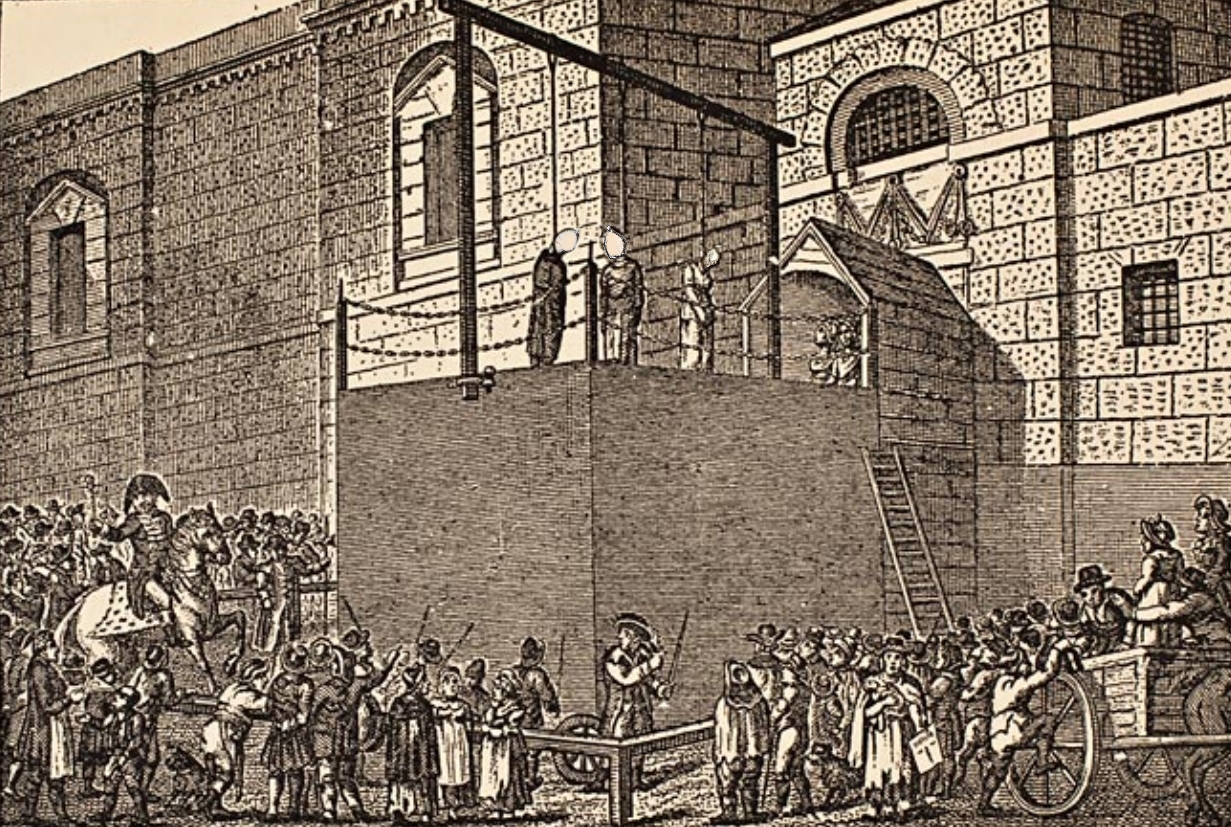
Suspension hanging.
This method is currently used in Iran for public hangings and was also used for some executions when the Taliban controlled Afghanistan where executees were hanged from the barrels of tanks and from mobile crane jibs. In Iran, both mobile crane and recovery truck jibs are used. All of these have hydraulic mechanisms for raising them, so the jib serves as both the gallows and the means of getting the prisoner suspended.
In America, instead of the conventional gallows that dropped the prisoner through a trapdoor, some states used a method where weights connected to the rope jerked the person upwards when they were released by the hangman. This method was used in 1874, for the hanging of William E. Udderzook in West Chester, Pennsylvania and also for Charles Thiede in Utah in 1896.
Connecticut used a similar arrangement for the execution of Gerald Chapman on April the 26th, 1926. A weight was connected to the rope which passed over a pulley. The warden operated a lever with his foot to allow the weight to fall, so pulling Chapman 12 feet into the air with such force that his neck was broken. In New York state Roxalana Druze was rather less fortunate when she was hanged for the murder of her husband in 1887. As a result New York developed electrocution as its method of execution although men continued to be hanged there until the end of 1889.
Standard drop hanging.
A standardised drop, of between four and six feet, was used in many American hangings during the later part of the 19th century and into the early 20th century. This was not worked out against the weight of the individual, but was often equivalent to their height. It was considered as an advance on the short drop method previously used. A drop of this distance was often not sufficient to break the prisoner's neck, however, and many still died by strangulation, although in a lot of cases they were knocked unconscious by the force of the drop and the impact of the heavy coiled knot against the side of the neck. Occasionally, they were decapitated when the drop proved to be too long, as happened at the execution of Eva Dugan in Arizona in 1928. Standard drops were given to the eleven senior Nazis executed after the Nuremberg trials and several were reported to have died slowly. The Lincoln conspirators were given a drop of five feet at their hanging in 1865 and at least two of the four struggled for some time after they were suspended.
The "Long drop" or measured drop method.
In 1872, William Marwood introduced the concept of an accurately calculated drop for the execution of Frederick Horry at Lincoln prison, as a scientifically worked out way of giving the prisoner a humane death. This concept had been invented by doctors in Ireland and was in use there by the mid 1850’s. Longer drops were in use elsewhere by this time, e.g. in America and Ireland, but the short drop was still used by many countries at this time e.g. Austria, Czechoslovakia, Poland & Russia.
The long drop method was designed to break the prisoner’s neck by allowing them to fall a pre-determined distance and then be brought up with a sharp jerk by the rope. At the end of the drop, the body is still accelerating under the force of gravity but the head is constrained by the noose. If the eyelet is positioned under the left angle of the jaw it rotates the head backwards, which combined with the downward momentum of the body, breaks the neck and ruptures the spinal cord causing instant deep unconsciousness and rapid death. The later use of the brass eyelet in the noose tended to break the neck with more certainty. It is only in the last six inches or so of the drop that the physical damage to the neck and vertebrae occur as the rope constricts the neck and the force is applied to the vertebrae. The duration of this part of the process is between 0.2 and 0.3 of a second depending upon the length of drop given. Generally the diameter of the noose is found to have reduced some five to seven inches after the drop.
The accurately measured and worked out drop removed most of the prisoner's physical suffering and made the whole process far less traumatic for the officials who now had to witness it in the confines of the execution shed instead of in the open air.
The drop given in the 19th century was usually between 4 and 10 feet depending on the weight and strength of the prisoner. The weight used to calculate the correct drop is that of the prisoner's clothed body. Up to 1892, the length of drop was calculated to provide a final "striking" force of approximately 1,260 ft/lbs. force which combined with the positioning of the eyelet caused fracture and dislocation of the neck, usually at the 2nd and 3rd or 4th and 5th cervical vertebrae. This is the classic "hangman's fracture". The length of the drop was worked out by the formula 1,260 foot pounds divided by the body weight of the prisoner in pounds = drop in feet. Between 1892 and 1913, a shorter length of drop was used, probably to avoid the decapitation and near decapitations that had occurred with old table. The 1892 table produced a force of 840 ft/lbs. After 1913, other factors were also taken into account and the drop was calculated to give a final "striking" force of around 1,000 ft/lbs. The Home Office issued a rule restricting all drops to between 5 feet and 8 feet 6 inches as this had been found to be an adequate range. In Britain, the drop was worked out and set to the nearest quarter of an inch to ensure the desired outcome.
A proper table of drops for hangmen to use was issued by the Home Office in 1892 and were subsequently revised in 1913. The 1913 table is still used in Singapore and probably Malaysia and may have been adopted by other countries which use the British method, e.g. Australia, Canada, the Caribbean nations and Egypt. Pakistan, India and Bangladesh use the measured long drop but it is not known whether they use the British drop tables.
British drop tables.
The weight of the prisoner is the weight recorded when they were weighed, clothed, the day before execution.
| 1892 table | 1913 table | ||
| Weight of prisoner | Drop in feet & inches | Weight of prisoner | Drop in feet & inches |
| 105 & under | 8’ 0” | - | - |
| 110 | 7’ 10” | - | - |
| 115 | 7’ 3” | 118 & under | 8’ 6” |
| 120 | 7’ 0” | 120 | 8’ 4” |
| 125 | 6’ 9” | 125 | 8’ 0” |
| 130 | 6’ 5” | 130 | 7’ 8” |
| 135 | 6’ 2” | 135 | 7’ 5” |
| 140 | 6’ 0” | 140 | 7’ 2” |
| 145 | 5’ 9” | 145 | 6’ 11” |
| 150 | 5’ 7” | 150 | 6’ 8” |
| 155 | 5’ 5” | 155 | 6’ 5” |
| 160 | 5’ 3” | 160 | 6’ 3” |
| 165 | 5’ 1” | 165 | 6’ 1” |
| 170 | 4’ 11” | 170 | 5’ 10” |
| 175 | 4’ 9” | 175 | 5’ 8” |
| 180 | 4’ 8” | 180 | 5’ 7” |
| 185 | 4’ 7” | 185 | 5’ 5” |
| 190 | 4’5” | 190 | 5’ 3” |
| 195 | 4’ 4” | 195 | 5’ 2” |
| 200 & over | 4’ 2” | 200 & over | 5’ 0” |
The graph below shows how long it takes to drop a given distance.
How hanging causes death.
Short drop and simple suspension hanging.
Hanging with little or no drop may cause death by strangulation (asphyxia) due to the weight of the person's body on the noose, causing it to tighten, so constricting the trachea (air passage). In this case the condemned typically exhibit signs of physical struggling for some time after suspension, 1-3 minutes being normal. There is then often a quiescent phase before what can be described as the convulsive phase which is thought occurs after consciousness has been lost. You can read reports of executions in the 18th/19th centuries where the person was said to be “greatly convulsed” The legs were drawn up and their chests heaved but this does not necessarily indicate consciousness in the second phase.
It was often reported in the 17th and 18th centuries that the prisoner died "almost without a struggle” and they would be seen to writhe in pain for just a few seconds, if at all, before going limp. This is because of pressure of the tightening noose occluding the jugular vein and carotid arteries causing cerebral ischemia, i.e. a severely reduced blood supply to the brain. Compression of the carotid bodies by the noose can also cause rapid heart stoppage due to carotid sinus reflex. In a recent public hanging in Iran which was filmed the two male prisoners seemed to go limp as soon as they were hoisted into the air and showed no signs of physical struggle. The third prisoner, a woman, struggled hard for approximately one minute before becoming still. (See later for a description of this execution)
The vertebrae protect the vertebral and spinal arteries which also supply blood to the brain. However, these arteries go outside the fourth vertebrae instead of inside it, which subjects them to blockage if the pressure on the neck is high enough (usually about 40-50 lbs. for a normal person) and this can cause the loss of consciousness in less than 15 seconds. During suspension, once the prisoner has become unconsciousness, rippling movements of the body and limbs may occur for some time which are usually attributed to nervous and muscular reflexes. Where death has been caused by strangulation, the face will typically have become engorged and cyanosed (turned blue through lack of oxygen). There will be the classic sign of strangulation - petechiae - little blood marks on the face and in the eyes from burst blood capillaries. The tongue may protrude. Where death has occurred through carotid or Vagal reflex, the face will typically be pale in colour and not show petechiae. There exist many reports and pictures of actual short drop hangings which seem to show that the person died quickly and fairly peacefully, while others indicate a slow and agonising death by strangulation.
Occasionally, a prisoner can be revived, even after hanging for half an hour and there are several recorded cases of this where people lived for many years afterwards. In Britain, to prevent survival, a slightly longer drop of about 12-18 inches became normal to ensure death, however, this extra drop tended to cause the condemned to suffer more as it was not long enough to break the neck but the force of it tore the neck muscles and sometimes the skin.
“Pole hanging”.
Austria, Czechoslovakia and Hungary used an unusual variant of short drop hanging. There was no gallows as such, but rather a stout vertical wooden pole (or post) of about 2-3 meters height with a metal hook or eye bolt at the top to which a thin rope noose was attached. There was either a ladder or steps up to a small platform at the back of the pole for the executioner to stand on. The pinioned prisoner was placed with their back to the pole and then lifted up either manually by the hangman’s assistants, on a simple board platform or by a cloth sling running under their armpits so that the executioner could put the noose round their neck. At the signal they were now jerked downwards by the assistants thus tightening the noose. This jerk combined with the thinness of the cord typically caused a carotid reflex and led to rapid unconsciousness. Late 19th century Austrian hangman, Josef Lang, considered this method to be far more humane than American style standard drop hanging and claimed that no criminal suffered for more than a minute with his method. It is unclear when pole hanging ceased although it was definitely in use until after the end of World War II and was used on various war criminals. A video of the hanging of Karl Hermann Frank which took place on the 22nd of May 1946 in Prague’s Pankrác Prison is currently available on YouTube. He was lifted up to the top of the pole by a sling and then dropped about a meter, the hangman covering Frank’s face with his hand. This film clearly demonstrates how pole hanging worked and does not give the impression that Frank struggled after suspension. There are also photos of the execution of Serbs by the Austrians during the war. It is quite probable that Milada Horakova (female) who was convicted of treason by the communist regime in Czechoslovakia suffered this death when she was hanged on 27th of June 1950. It has been reported that her executioner was ordered to “let the bitch suffocate”.
After the end of World War II, Albert Pierrepoint who hanged eight men at Karlou in Austria for war crimes, taught Austrian hangmen the British method and this was used for the last few executions there. Austria’s last execution took place on the 24th of March 1950 when Johann Trnka was hanged for murder. It is not known whether Czechoslovakia and Hungary continued to use pole hanging or a more conventional gallows for executions from the 1950’s. Czechoslovakia’s last execution was in 1989 and Hungary’s in 1988.
Standard drop hanging.
Where the standard drop proves inadequate to break the neck, the prisoner seems often to suffer a more cruel death than where little or no drop is used. The force generated by a drop of 5 or 6 feet is very considerable and does great damage to the skin, muscles and ligaments of the neck but does not necessarily induce asphyxia any sooner. This description of a hanging at San Quentin prison in California is from Clinton Duffy who was the warden there from 1942 to 1954 and relates to the execution of Major Raymond Lisemba on May 9th, 1942. "The man hit bottom and I observed that he was fighting by pulling on the straps, wheezing, whistling, trying to get air, that blood was oozing through the black cap. I observed also that he urinated, defecated, and droppings fell on the floor, and the stench was terrible". "I also saw witnesses pass out and have to be carried from the witness room. Some of them threw up."
It took ten minutes for the condemned man to die. When he was taken down and the cap removed, "big hunks of flesh were torn off" the side of his face where the noose had been, "his eyes were popped," and his tongue was "swollen and hanging from his mouth. His face had turned purple." Fortunately not all standard drop hangings were so gruesome and many prisoners did not show any signs of physical suffering.
The measured or long drop.
It takes between a half and three quarters of a second for a person to reach the end of the drop after the trap opens. The force produced by the prisoner's body weight multiplied by the length of fall and the force of gravity, coupled with the position of the noose is designed to violently jerk the person’s head backwards and sideways. In medical terms this is known as hyperflexion of the neck, which causes fracture-dislocation of the upper neck vertebrae, ideally between the C2 & C3 vertebrae, crushing or severing the spinal cord leading to immediate unconsciousness. The cause of death is however comatose asphyxia as the rope constricts the Carotid Artery, Jugular vein and the trachea (wind-pipe). It is thought that brain death will occur in around 6 minutes and whole body death normally within 10-15 minutes. It is very variable, however, with official reports of from 3-25 minutes for total death to have occurred. Some slight movements of the limbs and body may occasionally occur but are almost certainly due to spinal reflexes. Here is an official government photograph of the long drop hanging of an Iranian drug trafficker in Kuwait in 1998.
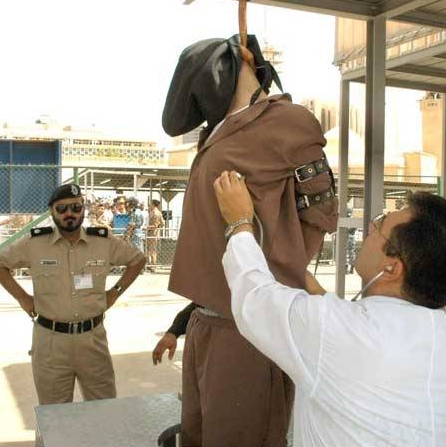
The Post-mortem report.
Some parts Britain, e.g. London typically carried a post-mortem during the 20th century on the executed person's body to establish the exact cause of death and we are fortunate to have the report of Ruth Ellis' autopsy as carried out by Professor Keith Simpson, who was one of the most eminent pathologists of his day. I have reproduced it as closely as possible to the original 1950's typewriter style. Post mortems were also carried out in other countries.
| POST MORTEM EXAMINATION Name Ellis, Ruth Apparent Age 28 years.At H. M. Prison, Holloway Date July 13 1955. | |
| EXTERNAL EXAMINATION How long dead | Well nourished Evidence of proper care and attention. Height 5ft.2ins. Weight 103 lbs. DEEP IMPRESSIONS AROUND NECK from noose with a suspension point about 1 inch in front of the angle of the L. lower jaw. Vital changes locally and in the tissues beneath as a consequence of sudden constriction. No ecchymoses in the face, or indeed, elsewhere. No marks of restraint. 1 hour. |
| INTERNAL EXAMINATION Skull ... ... ... Basic Meninges Mouth, tongue, Oesophagus ... ... Larynx, Trachea, Lungs Pericardium, Heart and blood vessels ... ... Stomach and contents ... Peritoneum Intestines, etc. ... Liver, and Gall bladder Spleen. Kidneys and Ureters Bladder etc. ... ... ... Generative organs | Fracture - dislocation of the spine at C2 with a 2 inch gap and transverse separation of the spinal cord at the same level. Fracture of both wings of the Hyoid and R. wing of the Thyroid cartilage, larynx also fractured. Air passages clear and lungs quite free from disease or other change. No engorgement. No asphyxial changes. No organic changes. No petechiae or other evidence of organic change. Small food residue, and odour of brandy. No disease. Normal. Terminal congestion only. Normal. Slight terminal congestion only. Lower abdominal operation scar for ectopic pregnancy operation in L. tube, now healed. No pregnancy. |
| Other remarks ... | Deceased was a healthy subject at the time of death. Mark of suspension normally situated and injuries from judicial hanging - to the spinal column - such as must have caused instant death. |
| CAUSE OF DEATH ... | Injuries to the central nervous system consequent upon judicial hanging. |
M. D. Lond.
146, Harley St. W. 1 and Guy's Hospital (Pathologist)
Registrar in Forensic Medicine London University
Note : ecchymoses is the medical term for subcutaneous bleeding (i.e. under the skin)
After death by any form of hanging, the body will typically show the marks of suspension, e.g. bruising and rope marks on the neck. In some cases there will have been effusions of urine and faeces as the sphincter muscles become deprived of oxygen and thus relax. The opening of the sphincters can also be caused by an adrenaline rush which is common in circumstances of extreme fear.
Total body death results usually within less than 30 minutes as the cells becomes starved of oxygen. This was one of the reasons why prisoners were left hanging for an hour in Britain. It is noteworthy that irrespective of the method of hanging it seems to take about the same time for total body death to occur.
Total body death results usually within less than 30 minutes as the cells becomes starved of oxygen. This was one of the reasons why prisoners were left hanging for an hour in Britain. It is noteworthy that irrespective of the method of hanging it seems to take about the same time for total body death to occur.
Experiments were carried out by F.E. Buckland, the assistant director of pathology, British Army of the Rhine, on Nazi war criminals executed by the British at Hameln prison in Germany after World War II and these found, that although the prisoners were rendered unconscious by the drop the heart could continue to beat for up to 25 minutes after execution. This created a problem because it meant that it would take far longer to carry out the batches of executions. It was thus proposed that the medical officer present would inject 10cc of chloroform into the prisoner 30 seconds after the drop had been given. It was found that if the chloroform was injected directly into the heart it immediately stopped beating and if injected intravenously into the arm the heart would stop in seconds. This procedure was first used at the execution of 10 men and three women on the 13th of December 1945.
On the 8th of March 1946 Albert Pierrepoint hanged eight men at Hameln and it was decided not to inject chloroform. The prison doctor listened to their hearts with a stethoscope in the normal way and recorded his results. These showed that it took between 10 and 15 minutes for audible heart beats to cease. On the 15th of May 1946 a further ten executions were carried out and this time the condemned were wired up to an electrocardiograph, which recorded the electrical activity of the heart. It showed that impulses were produced for a further ten minutes; taking the total time to 25 minutes. A human heart has a sinoatrial node which is located in the upper wall of the right atrium. This is also referred to as the heart’s pacemaker and its contractions generate nerve impulses that travel throughout the heart wall causing both atria to contract. There are other auto-rhythmic nodes that also effect heart rate.
Male prisoners sometimes have penile erections (priapism) after hanging due to the pooling of blood in the legs and lower body once the heart stops. The original photograph of the execution of the Lincoln conspirators in America in 1865 appears to show one of the men, Lewis Powell, had an erection after he was hanged.
Men may also reach orgasm on the rope. Dr. Charles Croker King was a surgeon in Ireland in the mid 19th century and was able to examine the body of John Hurley who was hanged on the 27th of August 1853 at Galway, immediately after the execution. Hurley’s neck was not broken by the drop. King noted that Hurley’s penis was erect and that there was a whitish liquid that had come from it. He took a slide of this and examined under a microscope, finding spermatozoa. This together with the other post mortem findings was reported in his treatise “On Death by Hanging” published in 1854. King was professor of anatomy and physiology at Queen’s College Galway. Orgasm may be caused by the stimulation of the penis during the conscious struggling phase, combined with the pressure on the Vagal nerve which is responsible for sexual arousal, together with the reduced level of oxygen reaching the brain.
In the handwritten autopsy notes of a hanging by the famous pathologist Sir Bernard Spilsbury, he states that there was no "seminal effusion" which implies that he had found this on occasion.
Execution equipment.On the 8th of March 1946 Albert Pierrepoint hanged eight men at Hameln and it was decided not to inject chloroform. The prison doctor listened to their hearts with a stethoscope in the normal way and recorded his results. These showed that it took between 10 and 15 minutes for audible heart beats to cease. On the 15th of May 1946 a further ten executions were carried out and this time the condemned were wired up to an electrocardiograph, which recorded the electrical activity of the heart. It showed that impulses were produced for a further ten minutes; taking the total time to 25 minutes. A human heart has a sinoatrial node which is located in the upper wall of the right atrium. This is also referred to as the heart’s pacemaker and its contractions generate nerve impulses that travel throughout the heart wall causing both atria to contract. There are other auto-rhythmic nodes that also effect heart rate.
Male prisoners sometimes have penile erections (priapism) after hanging due to the pooling of blood in the legs and lower body once the heart stops. The original photograph of the execution of the Lincoln conspirators in America in 1865 appears to show one of the men, Lewis Powell, had an erection after he was hanged.
Men may also reach orgasm on the rope. Dr. Charles Croker King was a surgeon in Ireland in the mid 19th century and was able to examine the body of John Hurley who was hanged on the 27th of August 1853 at Galway, immediately after the execution. Hurley’s neck was not broken by the drop. King noted that Hurley’s penis was erect and that there was a whitish liquid that had come from it. He took a slide of this and examined under a microscope, finding spermatozoa. This together with the other post mortem findings was reported in his treatise “On Death by Hanging” published in 1854. King was professor of anatomy and physiology at Queen’s College Galway. Orgasm may be caused by the stimulation of the penis during the conscious struggling phase, combined with the pressure on the Vagal nerve which is responsible for sexual arousal, together with the reduced level of oxygen reaching the brain.
In the handwritten autopsy notes of a hanging by the famous pathologist Sir Bernard Spilsbury, he states that there was no "seminal effusion" which implies that he had found this on occasion.
The gallows.
All manner of patterns of gallows have been used worldwide over the years. Simple gallows, having an upright with a projecting beam cross braced to it were commonly used in many countries, even up till the end of the World War II.
However for a variety of reasons, gallows’ designs became more elaborate. From 1783, the gallows at Newgate in London had a trapdoor and as the concept of giving the prisoner some drop became more widely used, this style spread. The earliest use of the "New Drop", as it was called in Britain was on May 5th, 1760 for the execution of the Earl of Ferrers. This was in the form of a small box like structure rising about 12 inches from the main platform which would drop level with the floor when the hangman pulled away the supporting props.
The American gallows, shown in this picture, is what many of you would probably imagine a gallows to look like and is from 1894. This style was used extensively in America and most other countries up until the early part of the 20th century. The present day gallows in Washington's Walla Walla prison looks most unlike this traditional pattern, consisting simply of two massive iron eye bolts through which the rope passes, each set over a single leaf trap operated by an electromagnetic release mechanism. (See picture). America typically used a single leaf trap whereas Britain and countries which adopted British style hanging typically use(d) a two leaf trap.
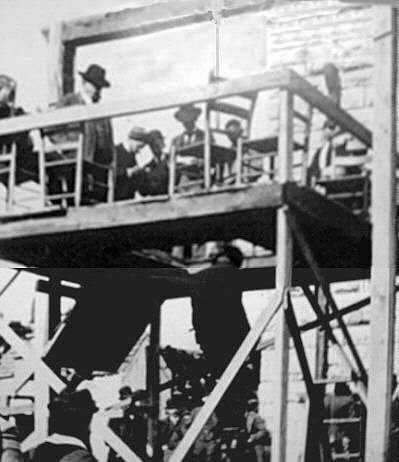
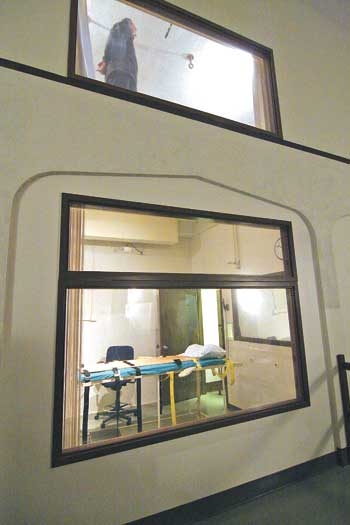
Modern gallows in Australia, Britain, Singapore, Malaysia and former British colonies typically have no steps and use double trapdoors, normally operated by a lever on the platform. South Africa used a metal beam that could be used for up to seven prisoners simultaneously at Pretoria Central Prison prior to abolition. In early 20th century British execution rooms there were no uprights, the ends of beam being set into the walls, while later a concealed beam running above the ceiling was used, as was the case at Pentonville and Wandsworth prisons in London up to abolition.
Lebanon used this quite complex style of gallows for public hangings - the picture is of the public execution of two men, carried out on the 25th of May 1998.
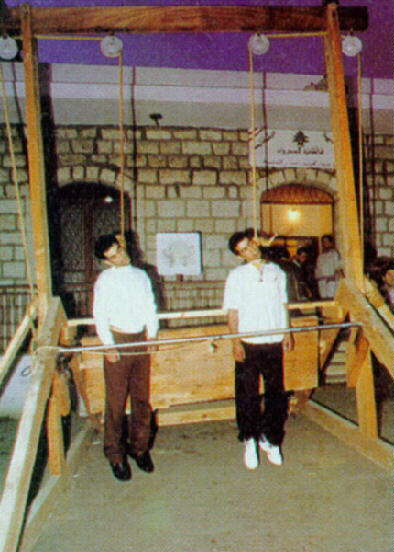
Visit the Gallows Galleries for pictures of gallows from Britain and around the world.
The Noose.
Several types of noose are in use worldwide. At its simplest, a noose is just a slip knot fashioned on a length of rope or strong cord. Nazi executioners used this pattern during World War II, typically made from 6-10 mm thick cord.
The traditional hangman's noose (picture) has from 5 to 13 coils which slide down the rope delivering a heavy blow to the side of the neck. This pattern is still used in America and countries such as Iran and Iraq. The modern American coiled noose is prepared in accordance with a procedure laid down in a U.S. army manual, from 30 feet of 3/4"-1" diameter manila hemp rope, boiled to take out stretch and any tendency to coil. It is formed into six coils and then waxed, soaped or greased to assure that the knot slides easily. Generally the knot is placed under the prisoner’s left ear (the subaural position) as was seen in the photographs of Saddam Hussein.
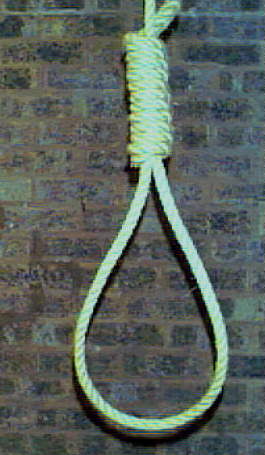
Britain and most Commonwealth and ex-Commonwealth countries use(d) a simple noose consisting of a loop worked into one end of the rope with the other end passed through it, as shown here. In the 20th century the eyelet was typically placed below the angle of the jaw, (the submental position)
This was improved in the 1890's by passing the free end of the rope through a brass eyelet instead of a loop of rope, which made it more free running. This type of noose has been shown to cause a quicker death. It is usually made from a 13 foot length of 3/4" diameter hemp rope, often bound with leather, as seen here. This type of noose is used in present day Egypt, Kuwait, Singapore and Malaysia and in former British colonies. Modern materials such as Nylon have been tried but tended to be too elastic for long drop hangings. Iran uses nylon rope for its short drop/suspension hangings.
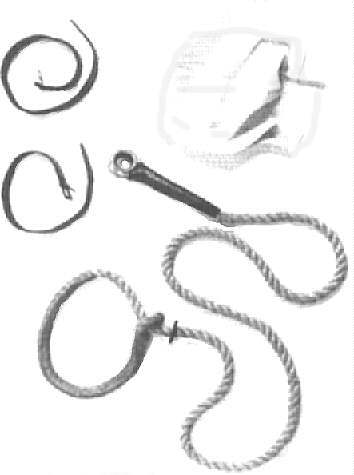
The hood.
In most countries, at least throughout the 20th century, it has been customary to hood the prisoner before execution. Normally, a black cotton or denim hood is used as shown here, but in some countries, notably Britain and its former colonies, a white linen or cotton hood was the norm as seen here. In South Africa and Australia a white hood was also used which was put on in the prisoner's cell prior to them being led into the gallows chamber. Unlike the British version, it had a flap over the eyes which was only closed just before the drop. Typically, the prisoner is hooded only at the last moment before the noose is put round their neck and adjusted. Although they are able to see the gallows, the trap, the executioner and witnesses and the noose dangling before them, most countries found it to be better than hooding them earlier and trying to lead them to the gallows, as they were more frightened by not knowing what was happening. It is thought that Iraq, Malaysia and Singapore hood the prisoner before leading them to the execution chamber.
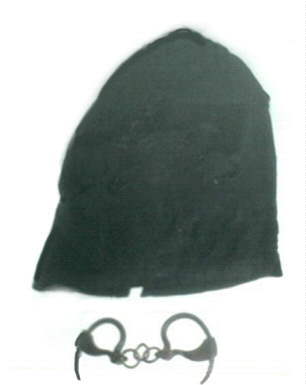
Some places such as Iran do not use a hood, although a blindfold may be used at some public executions. There are three good reasons for hooding the prisoner. Firstly, in long drop hangings it is very important that the condemned person does not move at the last moment, just as the lever is being pulled - which could easily alter the position of the noose and thus cause them a slower death.
The second reason is to minimise rope burn and marking of the skin of the neck which is why the hood is generally put over the head before the noose. This also prevents the hood being blown off by the updraft created by the body falling.
Hooding saves the officials, who have to witness the execution, from seeing the condemned person's face as they are about to die and after suspension.
Pinioning.
In modern times it is normal to pinion the prisoner's hands either in front of them or more usually behind their back with either handcuffs or a leather strap. Some countries use additional straps for the arms or even elaborate leather harnesses for the arms and wrists, as in Kuwait. In long drop/standard drop hangings, the prisoner's legs are normally pinioned with a cord or strap around the ankles to prevent them getting their feet onto the sides of the trap when the doors fall. In Britain, as women's skirts got shorter in the 20th century, an extra strap was placed round the lower thighs to prevent the skirt billowing up as they dropped and exposing their underwear. Thigh straps were also used for men in some countries, notably in the USA.
For short drop and suspension hangings, the legs were and still are, often left free.
Charles Campbell, who was hanged in Washington in May 1994, was strapped to a special collapse board (visible in the photo of the Walla Walla gallows, above) as he was not able to support himself at the end. Other prisoners have been hanged strapped to chairs, both they and the chair falling through the trap.
Modern hangings described.
Many countries carry out hanging executions in complete secrecy, e.g. Botswana, Malaysia, Japan and Singapore so details are hard to come by. There are however, a few modern hangings which have been reported in detail or actually filmed.
Compare these to a 1950's British hanging described in my History of Judicial Hanging in Britain.
A Kuwait hanging in 2004.
Three men who had been convicted of a particularly cruel “honour” murder of a little girl called Amna Al-Khaledi were hanged at the Nayef Palace in Kuwait City on Monday the 31st of May 2004. The prisoners were Marzook Saad Suleiman Al-Saeed, aged 25, Saeed Saad Suleiman Al-Saeed, aged 28, and 24-year-old Kuwaiti Hamad Mubarak Turki Al-Dihani. They were brought to the Nayef Palace at 8.45 on the Monday morning and were allowed time to prepare and pray before they were hanged. At about 9.45 they were led to the white painted metal and wood gallows wearing regulation brown boiler suits and with their wrists and arms strapped behind them with leather straps. Here they were made to climb the steps up onto the platform some 10 feet above and were placed upon individual double trap doors. Each prisoner was allocated a three man execution team, all wearing black overalls and ski masks. Once on the trap a leather strap was placed around each man’s ankles and a British style, leather covered eyelet noose placed over his head, held in place by a heavy rubber washer and followed by a black hood. They were given measured drops (of about 7 feet) and afterwards examined by doctors with stethoscopes to determine the time of death. Marzook Saad Suleiman Al-Saeed was pronounced dead after eight minutes, Hamad Al-Dehani took six minutes to die, and Saeed Saad Suleiman Al-Saeed expired in five minutes and 20 seconds. The time of death being stated as when there is no longer a audible heartbeat. From the photographs and the length of drop it is likely that their necks were broken. There was no report of any of the men struggling after the drop fell and all seemed to become limp immediately. The aftermath of the execution was witnessed by over 1000 people, including Amna’s relatives who were let into the compound to view the dangling bodies. The scene was photographed by press photographers for publication in the following day’s papers. Click here for a photograph. It is interesting to note that the time taken for these men to die is about the same as recorded in typical lethal injection executions in the USA.
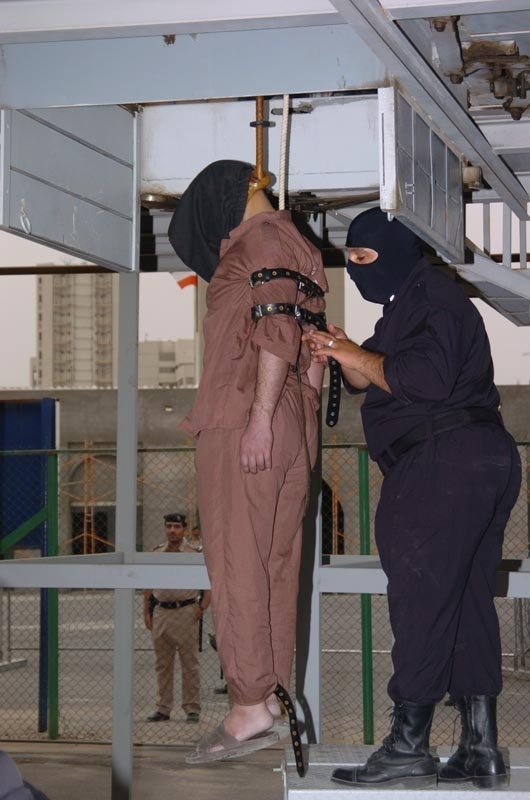
Saddam Hussein hanged in Iraq in 2006.
Probably the most high profile execution in modern times took place on at 6:10 a.m. on December the 30th 2006 when the former Iraqi dictator, Saddam Hussein was hanged by his own people in a two-story building in the Shia Khadamiya District in Northern Baghdad. Saddam was dressed in a white shirt and dark overcoat for his execution. He was led up the long flight of steps to the gallows platform where he was positioned over the chequer plate metal trap doors. The rope was looped through a metal eye on the ceiling and the free rope hung down to its attachment point. A black scarf and a seven coil American style noose were placed round his neck. He refused the traditional hood and after being taunted by his guards, the trapdoors were released and he dropped a little more than his own height through the trap and was brought to a halt by the noose which had its knot positioned under his left ear. From the cell phone video and still photographs it would seem that his neck was broken and that he died without any struggle. He was taken down after hanging for just ten minutes. Click here for a photo. Saddam had been convicted of the murder of 148 Shias in the town of Dujail in the 1980s.
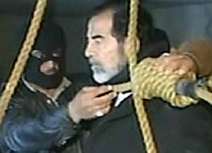
An Iranian hanging in 2007.
On the 15th of July 2007 a 29 year old Iranian woman, whose name was only given as Houriyeh, was hanged in public together with her two male accomplices. She had murdered her husband by strangling him in his sleep and paid the two men, Farhad and Reza, to murder three of her in-laws. They strangled her husband’s parents and stabbed his brother to death. Houriyeh was given a head-to-toe black chador for her execution which seems to be the standard dress for condemned women in Iran. The three prisoners were bought to the execution ground, their legs shackled and the hands cuffed behind them. The American style coiled nooses were attached to a spreader bar suspended from the jib of a crane. At the signal all three were simultaneously lifted off the ground and became fully suspended. The two men appeared to become unconscious almost instantly but a few seconds after being lifted into the air Houriyeh began to struggle hard, continuing for just over a minute before becoming still. Some 5,000 people, including judiciary and police officials, witnessed the execution and it was secretly videoed on a mobile phone. The video seems to bear out 19th century newspaper reports of short drop hangings in Britain and the USA, where women often seemed to die harder than men. Click here for a photograph.
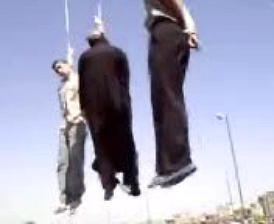
Does the prisoner feel pain where the drop is sufficient to break their neck?
Obviously no one can be sure but it is generally held that if the person does feel pain, it is only during the instant that their neck is broken which can be measured in fractions of a second (see below).
Those who witnessed 20th century British hangings never described any obvious suffering on the part of the prisoner and the two post-mortem reports that are available do not seem to indicate anything but a quick death. There were no signs of conscious suffering in the independently witnessed hangings of Westley Allan Dodd and Charles Campbell in Washington and Billy Bailey in Delaware. Although death was not instantaneous (it never is) unconsciousness was.
Obviously no one can be sure but it is generally held that if the person does feel pain, it is only during the instant that their neck is broken which can be measured in fractions of a second (see below).
Those who witnessed 20th century British hangings never described any obvious suffering on the part of the prisoner and the two post-mortem reports that are available do not seem to indicate anything but a quick death. There were no signs of conscious suffering in the independently witnessed hangings of Westley Allan Dodd and Charles Campbell in Washington and Billy Bailey in Delaware. Although death was not instantaneous (it never is) unconsciousness was.
According to Harold Hillman, a British physiologist who has studied executions, "the dangling person probably feels cervical pain, and suffers from an acute headache, as a result of the rope closing off the veins of the neck. It had been generally assumed that fracture-dislocation of the neck causes instantaneous loss of sensation. Sensory pathways from below the neck are ruptured, but the sensory signals from the skin above the noose and from the trigeminal nerve may continue to reach the brain until hypoxia blocks them." This would seem to be likely where the neck is not broken, e.g. in a standard drop US style hanging and may be accompanied by some physical struggling.
It has been calculated in evidence placed before the Aberdare Committee that it takes 0.2 of a second at the end of the drop for the rope to constrict and then break the neck. Other research into how the brain functions has revealed that a total loss of any awareness will take place within 0.3 of a second after the spinal cord has been completely severed. The process of unconsciousness is triggered by a reaction within the axons (nerve fibres) of the severed nerves. Normal nerve signals require an antagonistic process within the axons which can only happen if the nerve circuit is unbroken. If, however, all the large spinal nerves are disconnected from the brain stem, as they are in measured drop hanging or beheading, an extremely rapid reaction takes place in both ends of the severed nerves, leading to all nerve impulses becoming stochastic (random) instead of structured.
Consciousness is instantly lost when the process becomes stochastic, no matter how high the activity of the brain may have been prior to it . Furthermore, a self destroying process will begin in the axons, spreading from the point of damage, and destroying the nerves all the way to the main synapses within the brain. This process will be completed within only five seconds. On this basis where the spinal cord is severed, half a second is the maximum possible time that any pain could be felt. This is born out by observation and the total lack of any obvious signs of suffering in properly carried out measured drop hangings.
It should be clearly understood that suicide by hanging is likely to be VERY PAINFUL
as there will hardly ever be sufficient drop to break the neck.
as there will hardly ever be sufficient drop to break the neck.
Short drop or suspension hanging is, at least initially, likely to be very painful as the person struggles for air against the compression of the noose and against the weight of their own body, being supported entirely by the neck and jaw. Houriyeh above exhibited very obvious sings of suffering. While 1 to 3 minutes before unconsciousness sets in may not sound a long time it must feel like an eternity to the suspended and struggling prisoner.
It is sometimes possible to revive a person after short drop/suspension hanging and thus we can have an idea of what they felt. People who have survived hanging have described the pain diminishing after a while and seeing bright lights as they drift into unconsciousness.
An Iranian man identified only as Niazali, was hanged in February 1996 but survived after the victim's relatives pardoned him. He told the Iranian daily newspaper "Kayhan" what it had felt like. "That first second lasted like a thousand years. I felt my arms and legs jerking out of control. Up on the gallows in the dark, I was trying to fill my lungs with air, but they were crumpled up like plastic bags." Niazali’s hanging reportedly lasted 20 minutes.
Hanging versus Lethal Injection.An Iranian man identified only as Niazali, was hanged in February 1996 but survived after the victim's relatives pardoned him. He told the Iranian daily newspaper "Kayhan" what it had felt like. "That first second lasted like a thousand years. I felt my arms and legs jerking out of control. Up on the gallows in the dark, I was trying to fill my lungs with air, but they were crumpled up like plastic bags." Niazali’s hanging reportedly lasted 20 minutes.
Many people who support capital punishment feel that lethal injection is a better, more modern and humane form of execution than hanging. Is this view based upon the facts or is it purely a perception based on the fact that we have experienced (non-lethal) injections ourselves? It is noticeable that the a majority of the American respondents to my surveys cite lethal injection as the method they would choose for themselves, although a considerable minority of British respondents of both sexes chose hanging.
Execution by lethal injection takes much longer than any other method, anything up to 45 minutes for the complete process during which the prisoner is fully conscious except for the last 7-10 of those minutes (remember that in Britain a 20th century hanging took, typically 15-20 seconds to carry out). This duration must subject the prisoner to far more mental torture because they know they are being put to death. Lethal injection is clearly much less dramatic than hanging and, therefore, probably easier for the staff and witnesses to cope with. It is suitable for both sexes and all ages of prisoners where a suitable vein can be located. However, there is often a problem where the prisoner has been an intravenous drug user or simply has small veins which tend to contract even further when they are frightened.
One wonders if lethal injection is perceived as being as much of a deterrent as hanging in the minds of criminals or whether they would feel it was a "soft option"?
This is an important point because if the state is going to take the life of a person at all, then surely it should seek to produce the maximum deterrence from so doing without resorting to extreme cruelty. For a detailed look at lethal injection, click here.
Conclusions.
Carried out carefully and humanely, using an accurately measured drop and modern noose, hanging is possibly the least cruel way to execute a criminal. In 20th century Britain, the whole process was over extremely quickly and every effort was made to minimise the criminal's mental and physical suffering. However, as can be seen from the examples cited above, it can also be a very cruel death, if either botched or carried out in such a way as to intentionally cause suffering. It is probable that the countries that execute criminals using little or no drop in public do so in the hope of achieving maximum deterrence and feel that the criminal should be made to suffer for what they have done.
Subscribe to:
Posts (Atom)